
Free Fitness Drawing Sheet | Year 5 Greater Depth | BookFlik
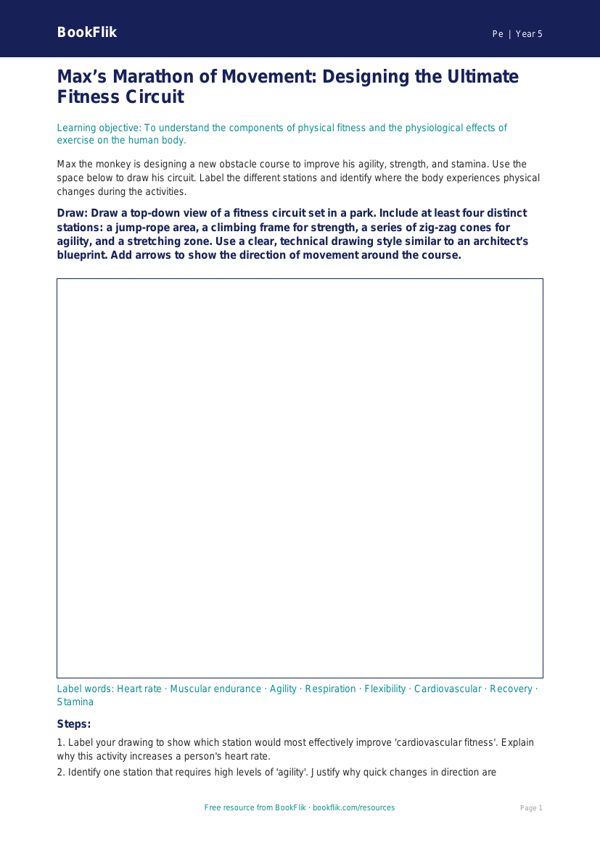
Boost your primary school physical education lessons with our comprehensive Pe fitness drawing sheet year 5 greater depth resource. Designed specifically for pupils who thrive on complex challenges, this high-quality educational tool encourages children to move beyond basic movement and analyse the physiological impact of exercise on the human body.
In line with the UK National Curriculum for Year 5, this resource bridges the gap between active participation and scientific understanding. While younger learners might focus on simply performing a squat or a sprint, those using this Pe fitness drawing sheet year 5 greater depth will be tasked with illustrating the musculoskeletal system in action. Pupils are required to draw and label specific muscle groups, identify joints involved in various athletic movements, and explain the importance of cardiovascular health.
Teachers can utilise this resource to facilitate a cross-curricular approach, blending PE with science. It serves as an excellent plenary activity after a high-intensity circuit session. By asking students to map their heart rate recovery or sketch the biomechanics of a specific jump, you reinforce their understanding of how the body adapts to physical exertion.
This Pe fitness drawing sheet year 5 greater depth is differentiated to support gifted and talented learners through open-ended inquiry. Instead of simple identification, the worksheet includes higher-order thinking prompts such as:
1. Explain why a warm-up is physiologically necessary before intense activity.
2. Compare and contrast the muscle usage in a long-distance run versus a short sprint.
3. Justify why consistent physical activity is essential for long-term health.
4. What might happen if our bodies could not store energy as glycogen?
5. Design an original, biomechanically efficient movement and sketch the muscle groups required to execute it.
6. Analyse the impact of hydration on muscular endurance.
Download this creative tool today to inspire your Year 5 cohort to think like sports scientists and artists simultaneously.
Preview the worksheet
If the preview does not load, open the PDF in a new tab.