
Free Gymnastics Assessment | Year 5 Greater Depth | BookFlik
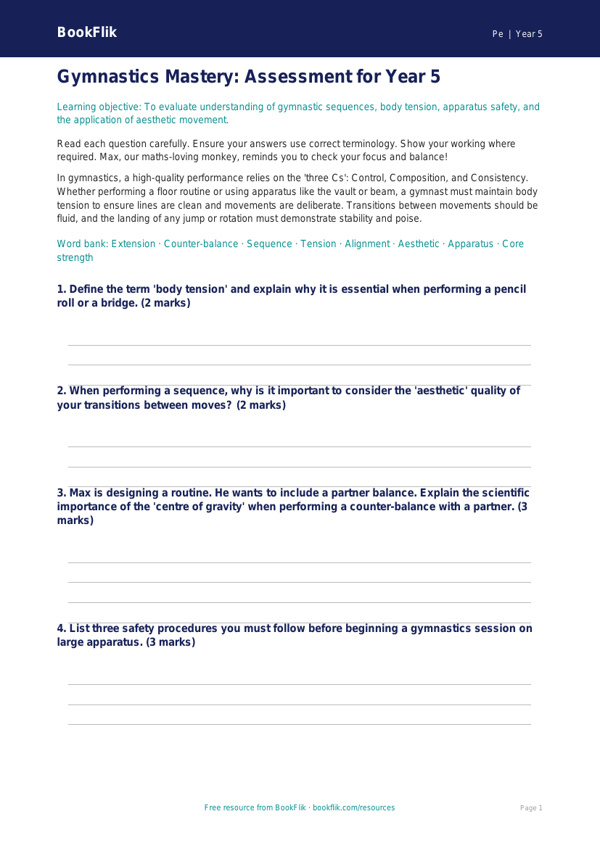
Boost your classroom teaching with our comprehensive PE gymnastics assessment year 5 greater depth resource, specifically designed to challenge your most able athletes. This free, teacher-ready pack provides a structured framework for evaluating complex movement patterns, sequence development, and the precise execution of gymnastic skills in line with the UK National Curriculum.
By utilising this PE gymnastics assessment year 5 greater depth material, educators can move beyond basic physical competence and encourage students to analyse the mechanics of movement. The resource focuses on core areas such as balance, transition, rotation, and travel, requiring pupils to link movements with fluidity and control. As students progress, they will learn how to refine their technique, maintain tension, and demonstrate an awareness of space and aesthetic quality in their routines.
This pack is ideal for teachers looking to differentiate their PE curriculum effectively. It provides clear criteria for pupils working at greater depth, ensuring that high-achieving learners are pushed to demonstrate advanced core stability and artistic expression. Whether your students are perfecting a controlled headstand or designing a complex floor sequence involving varying levels and speeds, this PE gymnastics assessment year 5 greater depth guide offers the perfect scaffolding to monitor their progress.
Included within the resource are 8 challenging tasks that require critical thinking. For example:
1. Explain why maintaining a tight core is essential for balance during a transition.
2. Compare and contrast the use of tension in a static pose versus a dynamic roll.
3. Justify your choice of movements when choreographing a routine for a specific musical tempo.
4. What might happen to the fluidity of your sequence if your transitions lack a clear starting and finishing point?
5. Design a sequence that incorporates three different levels of height.
6. Evaluate a partner’s routine, identifying one area for technical improvement and one for artistic flair.
7. How can you adapt a simple bridge movement to make it more complex?
8. Create a reflective diary entry about your performance.
Preview the worksheet
If the preview does not load, open the PDF in a new tab.