
Free Gymnastics Poster | Year 5 Greater Depth | BookFlik
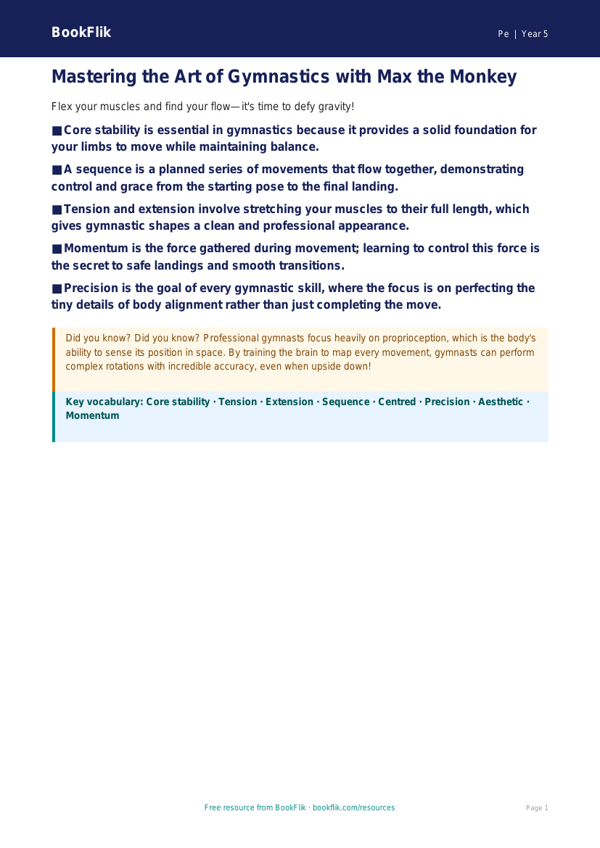
Enhance your primary classroom with our dynamic Pe gymnastics poster year 5 greater depth resource, specifically designed to challenge high-attaining pupils. This vibrant, educational tool moves beyond basic movement to explore the biomechanics and aesthetic principles of gymnastics, perfectly aligning with the UK National Curriculum requirements for physical education.
Our poster features Max the monkey, who treats every movement as a complex maths puzzle. By analysing body tension, centre of gravity, and the physics of rotation, pupils will gain a deeper understanding of what makes a balanced routine. This Pe gymnastics poster year 5 greater depth resource encourages students to move past simple sequences and begin evaluating the quality of their performance, focusing on precision, control, and extension.
Teachers can use this visual aid as a focal point for peer-assessment sessions. It provides the essential vocabulary needed for children to articulate their observations, such as symmetry, counter-balance, and fluid transitions. Whether you are teaching at a school hall or planning a theory-based lesson, this Pe gymnastics poster year 5 greater depth resource serves as an excellent prompt for critical thinking and reflective practice.
The content is meticulously crafted to stretch gifted and talented learners. It includes six rigorous questions designed to provoke higher-order thinking:
1. Explain why maintaining a tight core is essential when performing a controlled roll.
2. Compare and contrast the use of balance in a static pose versus a dynamic sequence.
3. Justify your answer: Does a gymnast with higher velocity always produce a better performance?
4. What might happen if a gymnast fails to distribute their weight evenly during a symmetrical movement?
5. How does the concept of symmetry enhance the aesthetic appeal of a gymnastics routine?
6. Design a sequence that incorporates three different levels of height and explain the physics behind your transitions.
Download this essential guide today to inspire your young athletes to think, analyse, and perform with excellence.
Preview the worksheet
If the preview does not load, open the PDF in a new tab.