
Free Swimming Word Mat | Year 5 Greater Depth | BookFlik
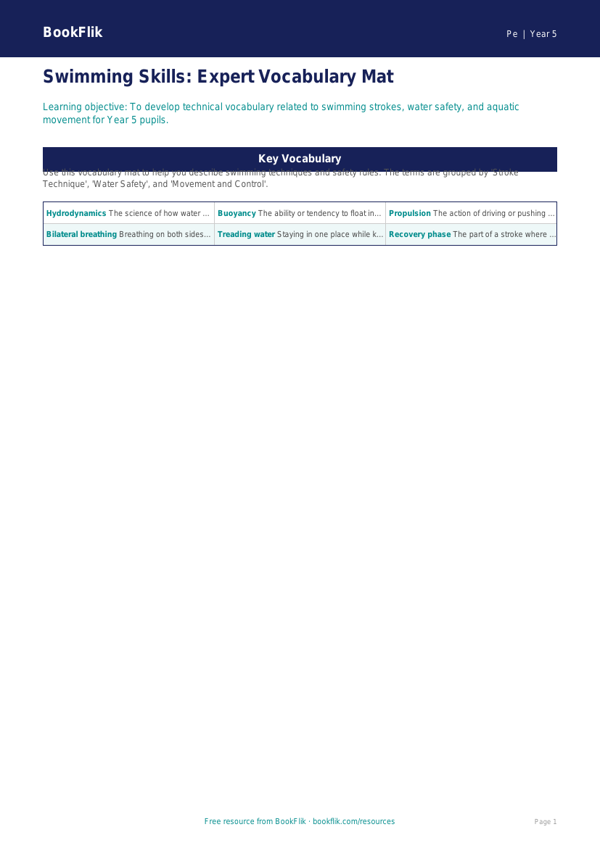
Boost your pupils’ aquatic vocabulary and performance with our premium Pe swimming word mat year 5 greater depth resource. Designed specifically for the UK National Curriculum, this comprehensive tool supports learners in mastering the technical language required for safe and efficient swimming.
This Pe swimming word mat year 5 greater depth is perfect for educators aiming to stretch their gifted and talented pupils. While standard resources focus on basic strokes, this mat introduces sophisticated terminology such as hydrodynamics, buoyancy, drag reduction, and bilateral breathing. By incorporating these precise terms, students can move beyond simple descriptions and begin to articulate the physics behind their movement in the water.
Teachers can use this resource to facilitate peer-to-peer feedback sessions. When pupils observe their classmates, they can use the mat to provide constructive critiques, using language like streamline, propulsion, and core stability to justify their observations. This aligns with the Year 5 PE programme of study, which emphasises the importance of evaluating personal and others’ performances to achieve improvement.
This Pe swimming word mat year 5 greater depth is differentiated to challenge high-achieving learners. It includes a section on the historical evolution of swimming styles and the scientific principles of water resistance. The mat features eight higher-order thinking questions designed to provoke deep discussion:
1. Explain why maintaining a horizontal body position is essential for reducing drag.
2. Compare and contrast the propulsion techniques used in front crawl versus breaststroke.
3. Justify why a swimmer might choose a bilateral breathing pattern during a long-distance swim.
4. What might happen if a swimmer fails to engage their core muscles during a tumble turn?
5. How does water density affect the amount of force required to move through the pool?
6. Evaluate the impact of streamline positioning on overall race times.
7. Design a short sequence of movements that demonstrates efficient buoyancy.
8. Create a reflective diary entry from the perspective of an Olympic athlete, using at least five key terms from this mat.
Preview the worksheet
If the preview does not load, open the PDF in a new tab.