
Free Classification Keys Word Mat | Year 5 Greater Depth | BookFlik
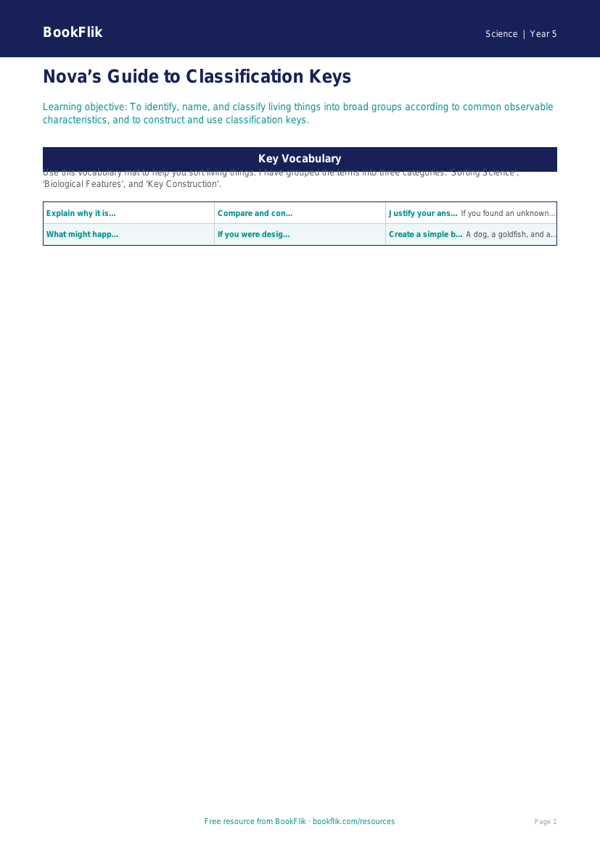
Mastering the complexities of biological grouping has never been more engaging with our exclusive Science classification keys word mat year 5 greater depth. Designed specifically for pupils who thrive on academic challenge, this resource elevates the standard curriculum requirements into a rigorous exploration of taxonomy and scientific nomenclature.
Aligned with the UK National Curriculum for Year 5, this word mat supports the objective of describing how living things are classified into broad groups according to common observable characteristics. While standard resources focus on simple branching, our Science classification keys word mat year 5 greater depth pushes learners to utilise precise biological terminology, such as vertebrate, invertebrate, arthropod, and mollusc. It encourages students to move beyond basic identification and instead analyse the structural nuances that define biological families.
Teachers can utilise this tool as a scaffold for independent research projects or as a prompt for classroom debates on evolutionary relationships. Whether your pupils are creating their own dichotomous keys to identify local flora or justifying the placement of a specific organism within a complex hierarchy, this mat provides the linguistic foundation required for high-level scientific communication. By incorporating this Science classification keys word mat year 5 greater depth into your lessons, you empower students to articulate their reasoning with clarity and precision.
The resource includes six higher-order thinking tasks designed to stretch gifted learners:
1. Explain why a spider is not classified as an insect, referencing specific anatomical features.
2. Compare and contrast the classification characteristics of amphibians and reptiles.
3. Justify your answer: If a new species were discovered, what criteria would you use to categorise it?
4. What might happen if an organism’s key characteristics were incorrectly identified?
5. Create a dichotomous key for five different species found in your local woodland.
6. Evaluate the limitations of using a simple branching key for complex evolutionary classification.
Download this essential resource today to inspire the next generation of biologists.
Preview the worksheet
If the preview does not load, open the PDF in a new tab.