
Free Earth And Space Poster | Year 5 Greater Depth | BookFlik
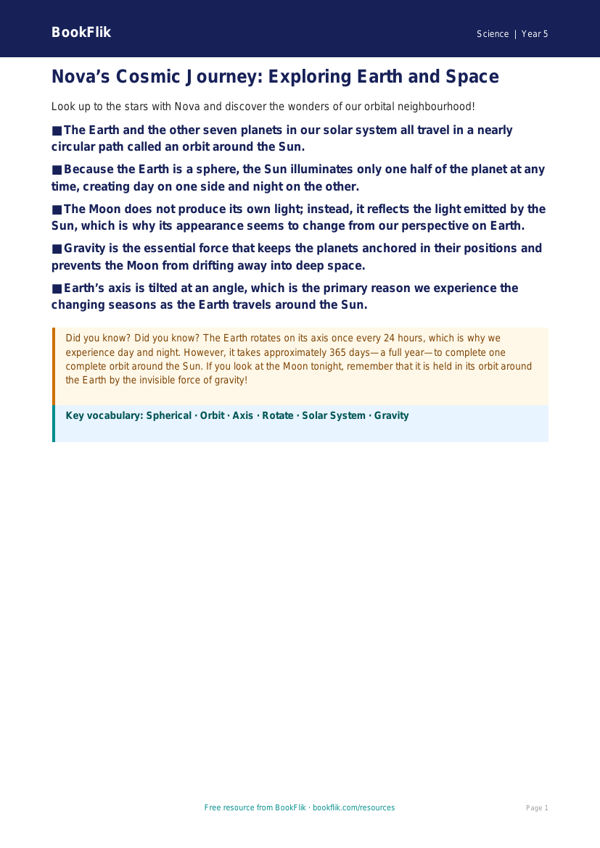
Ignite the curiosity of your pupils with our premium Science earth and space poster year 5 greater depth resource. Designed specifically to stretch the minds of high-achieving learners, this vibrant classroom display tool moves beyond basic facts to explore the complex mechanics of our solar system. Nova the barn owl serves as your guide, prompting pupils to look closer at the celestial movements that define our world.
This educational resource aligns perfectly with the UK National Curriculum for Year 5, specifically the Earth and Space programme of study. While standard resources often focus on naming planets, this Science earth and space poster year 5 greater depth resource encourages pupils to investigate the concept of a spherical Earth, the relative movement of the Earth and the other planets in the solar system, and the fascinating mechanics of the Earth’s rotation. It is an ideal addition to your science wall, providing a visual anchor for lessons on gravity, day and night, and the phases of the moon.
What sets this poster apart is its focus on higher-order thinking. We have integrated challenging prompts that require pupils to justify their scientific reasoning and analyse complex phenomena. Teachers can use this Science earth and space poster year 5 greater depth material to facilitate classroom debates, group research projects, or as a springboard for independent investigation. The inclusion of richer vocabulary—such as geocentric, heliocentric, axis, and orbit—ensures that gifted and talented learners are appropriately challenged.
The poster features six thought-provoking questions designed to push boundaries. Pupils are asked to explain why the sun appears to move across the sky, compare and contrast the gravitational pull of different planets, and justify their answers regarding the seasonal changes observed on Earth. With its clear, engaging design and focus on critical analysis, this resource is an essential tool for any Year 5 teacher aiming to inspire the next generation of astronomers.
Preview the worksheet
If the preview does not load, open the PDF in a new tab.