
Free Everyday Materials Drawing Sheet | EYFS Core | BookFlik
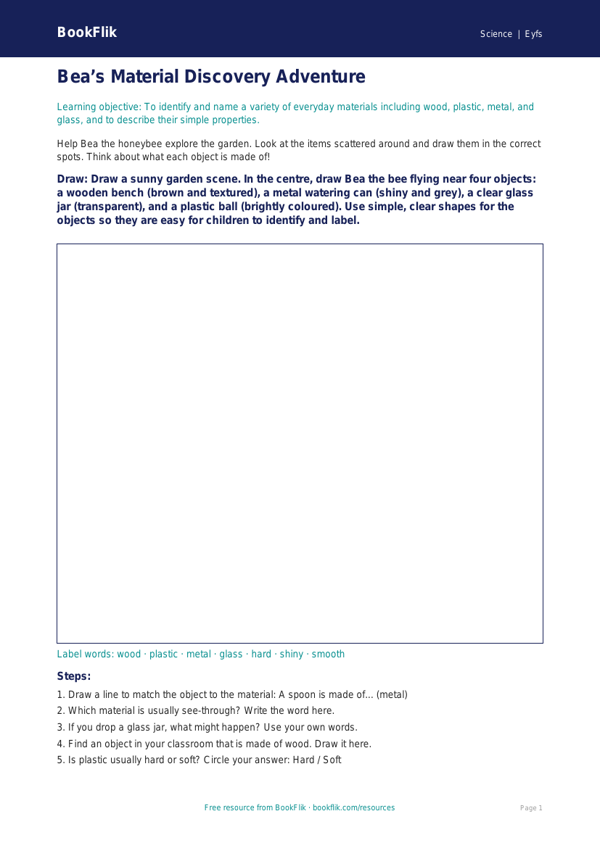
Bring your classroom to life with our engaging Science everyday materials drawing sheet eyfs core resource. Designed specifically for children aged 3 to 5, this printable activity helps little learners explore the world around them by identifying, categorising, and describing the properties of objects found in their daily lives. By using this Science everyday materials drawing sheet eyfs core, children will develop their observation skills while learning to differentiate between materials like wood, plastic, metal, and fabric.
Aligned with the UK National Curriculum for Early Years Foundation Stage (EYFS), this resource supports the Understanding the World area of learning. It encourages children to explore the natural and man-made environment, sparking curiosity about why certain objects are made from specific materials—for example, why a spoon might be metal or a teddy bear might be soft fabric. This Science everyday materials drawing sheet eyfs core is set at the core level, perfect for students working at the expected standard. It provides a structured yet creative way for children to demonstrate their understanding through art and labelling.
Teachers can use this sheet during circle time to prompt group discussions about textures and uses. It works perfectly as an independent task during continuous provision or as a guided activity to assess prior knowledge.
To help you check understanding, here are 5-7 questions to use alongside the sheet:
1. Can you name one object on your page that feels hard?
2. Why do you think we use metal to make a cooking pan?
3. Which item is made of plastic?
4. Can you find something in the room that is made of wood?
5. What happens if we try to bend a metal spoon?
6. Is this object smooth or rough to touch?
7. Which material would be best to keep us dry in the rain?
Download this free resource today to inspire your young scientists!
Preview the worksheet
If the preview does not load, open the PDF in a new tab.