
Free Food Chains Assessment | Year 5 Greater Depth | BookFlik
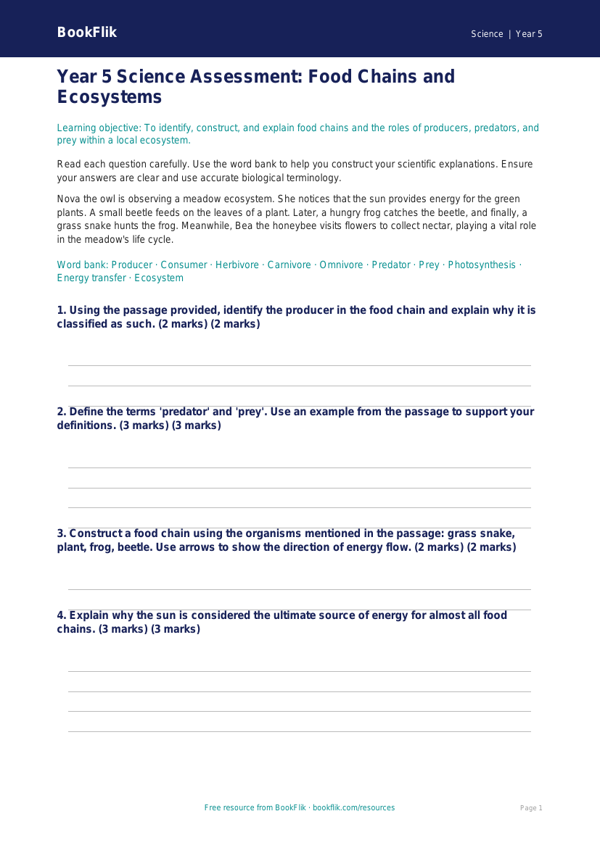
Are you looking for a challenging Science food chains assessment year 5 greater depth resource to stretch your most capable pupils? Our latest printable pack is designed specifically for Year 5 learners who require more than just basic recall. This comprehensive assessment encourages students to apply their knowledge of producers, consumers, and apex predators to complex, real-world ecological scenarios.
Aligned with the UK National Curriculum, this Science food chains assessment year 5 greater depth focuses on the interconnected nature of ecosystems. Rather than simply identifying links in a chain, pupils must analyse the impact of environmental changes on biodiversity. Through guided tasks, children will explore how the removal of a primary consumer affects the entire trophic level, justifying their reasoning with scientific evidence.
Teachers can use this resource as a formative assessment tool to gauge understanding or as a summative challenge at the end of a unit. With our original character, Bea the honeybee, leading the way, the material remains engaging while maintaining a rigorous academic standard. Each section is meticulously crafted to test mastery, moving beyond simple definitions into higher-order thinking. This Science food chains assessment year 5 greater depth includes six to eight multi-layered questions, such as: Explain why an apex predator is essential for maintaining ecosystem balance and What might happen if a non-native species were introduced to this habitat?
The pack also includes a creative extension task, inviting pupils to design a sustainable food web based on a specific biome. This ensures that the resource is perfect for gifted and talented learners who thrive on creative problem-solving and critical analysis. By focusing on scientific literacy and logical deduction, this pack provides the perfect balance of support and challenge for your classroom. Download this teacher-created resource today to elevate your Science lessons and inspire your budding ecologists to think more deeply about the natural world around them.
Preview the worksheet
If the preview does not load, open the PDF in a new tab.