
Free Food Chains Quiz | Year 5 Greater Depth | BookFlik
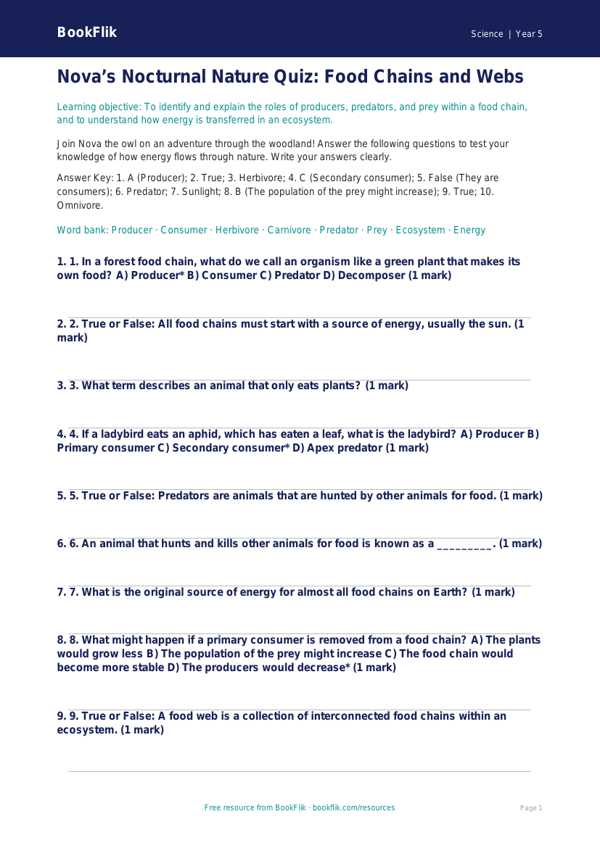
Boost your classroom engagement with our exclusive Science food chains quiz year 5 greater depth resource. Designed specifically for ambitious learners who have already mastered the basics of producers, consumers, and predators, this challenge pushes pupils to think like ecologists.
This comprehensive resource moves beyond simple identification tasks. Throughout the activity, students will join Bea the honeybee as she guides them through complex ecosystem interactions. By completing this Science food chains quiz year 5 greater depth, children will learn to analyse the impact of removing a specific species from an environment, predict the consequences of population fluctuations, and explain the transfer of energy through trophic levels with scientific precision.
Teachers can use this material as a formative assessment tool to identify pupils working at greater depth, or as a stimulating enrichment activity for early finishers. The content is perfectly aligned with the UK National Curriculum for Year 5 Science, specifically the requirements regarding living things and their habitats. We ensure that our materials encourage critical thinking by requiring students to justify their reasoning rather than simply selecting a correct option.
The differentiation is embedded within the questioning style. While standard tasks ask children to label a diagram, our Science food chains quiz year 5 greater depth demands that students evaluate the stability of ecosystems. The resource includes six to eight challenging questions, featuring higher-order prompts such as: Explain why a decline in primary producers would cause a cascading effect throughout a food web; Compare and contrast the energy transfer in terrestrial versus aquatic environments; and Justify your answer regarding why apex predators are often the most vulnerable to habitat loss.
Download this original, high-quality content today to inspire your most inquisitive young scientists. It is the perfect way to stretch their scientific vocabulary and deepen their understanding of our interconnected natural world.
Preview the worksheet
If the preview does not load, open the PDF in a new tab.