
Free Food Chains Template | Year 5 Greater Depth | BookFlik
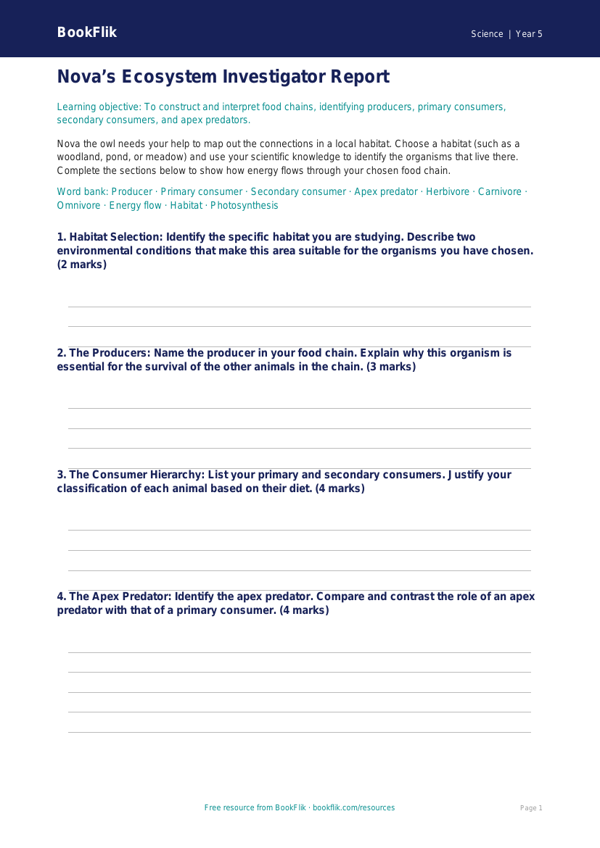
Unlock the secrets of ecosystems with our comprehensive Science food chains template year 5 greater depth resource. Designed specifically for ambitious learners, this educational pack moves beyond basic identification to explore the intricate energy transfers within habitats. Pupils will investigate how producers, primary consumers, secondary consumers, and apex predators interact, whilst developing a sophisticated understanding of biomass and trophic levels.
This Science food chains template year 5 greater depth is perfectly aligned with the UK National Curriculum, supporting the statutory requirements for Science in Upper Key Stage 2. Teachers can utilise this versatile resource to facilitate independent research projects, classroom debates, or structured small-group investigations. By providing a framework that encourages critical thinking, it allows educators to assess pupils’ grasp of complex biological concepts with ease.
What sets this resource apart is its focus on higher-order cognitive skills. Rather than simply labelling diagrams, students are challenged to analyse environmental shifts. For instance, they will be asked to justify why the removal of a single species can cause an entire ecosystem to collapse. This Science food chains template year 5 greater depth is ideal for those identified as gifted and talented, providing the necessary rigour to stretch their scientific vocabulary and analytical abilities.
The pack includes 8 challenging tasks, such as:
1. Explain why energy is lost at each stage of a food chain.
2. Compare and contrast the roles of decomposers and scavengers.
3. Justify your answer: Is a food web a more accurate representation of nature than a food chain?
4. What might happen if a non-native predator were introduced to a local pond?
5. Construct a complex food web for a rainforest biome.
6. Predict the long-term impact of climate change on a specific food chain.
7. Design an original experiment to test the effects of pollution on a producer.
8. Evaluate the importance of biodiversity in maintaining ecosystem stability.
Empower your Year 5 pupils to think like ecologists today.
Preview the worksheet
If the preview does not load, open the PDF in a new tab.