
Free Habitats Writing Frame | Year 5 Greater Depth | BookFlik
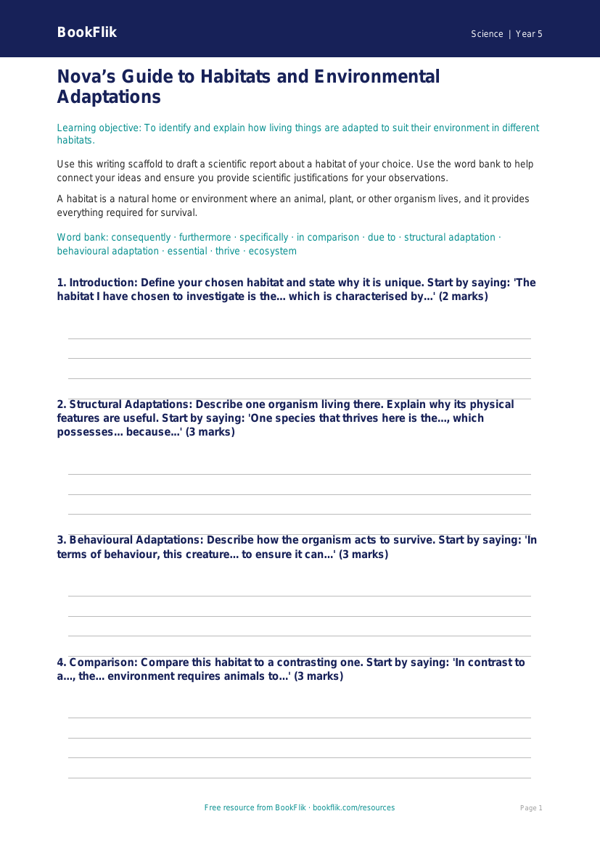
Spark curiosity in your classroom with our comprehensive Science habitats writing frame year 5 greater depth resource. Designed specifically for pupils who require an extra intellectual challenge, this tool moves beyond basic identification to encourage sophisticated scientific analysis. As students explore how environmental changes impact living things, they will develop the skills to justify their reasoning and evaluate complex ecological relationships.
This Science habitats writing frame year 5 greater depth resource aligns perfectly with the UK National Curriculum, specifically supporting the objective of recognising that environments can change and that this can sometimes pose dangers to living things. While standard learners might focus on naming species, your high-attaining pupils will be prompted to explain why specific adaptations are essential for survival in diverse biomes. Whether investigating the impact of deforestation or the consequences of rising sea temperatures, this frame provides the structure necessary for children to articulate their scientific findings with precision and academic flair.
How can teachers utilise this resource? It is an ideal companion for independent research projects or as a scaffold for structured argumentative essays. By using this Science habitats writing frame year 5 greater depth, educators can guide pupils to synthesise information and construct evidence-based conclusions.
The resource includes eight challenging tasks designed to stretch young minds:
1. Explain why a polar bear’s thick layer of blubber is a crucial evolutionary advantage.
2. Compare and contrast the adaptations of a desert cactus with a tropical rainforest fern.
3. Justify your answer: Why might an invasive species cause an entire ecosystem to collapse?
4. What might happen if a sudden drought occurred in a local woodland habitat?
5. Analyse the link between human urbanisation and the loss of biodiversity.
6. Propose a creative solution to protect a local endangered species.
7. Evaluate the long-term effects of water pollution on marine life.
8. Create a persuasive report advocating for the conservation of a specific habitat.
Download this essential teaching aid today to inspire your young scientists to think deeply about the natural world.
Preview the worksheet
If the preview does not load, open the PDF in a new tab.