
Free Habitats Assessment | Year 6 Core | BookFlik
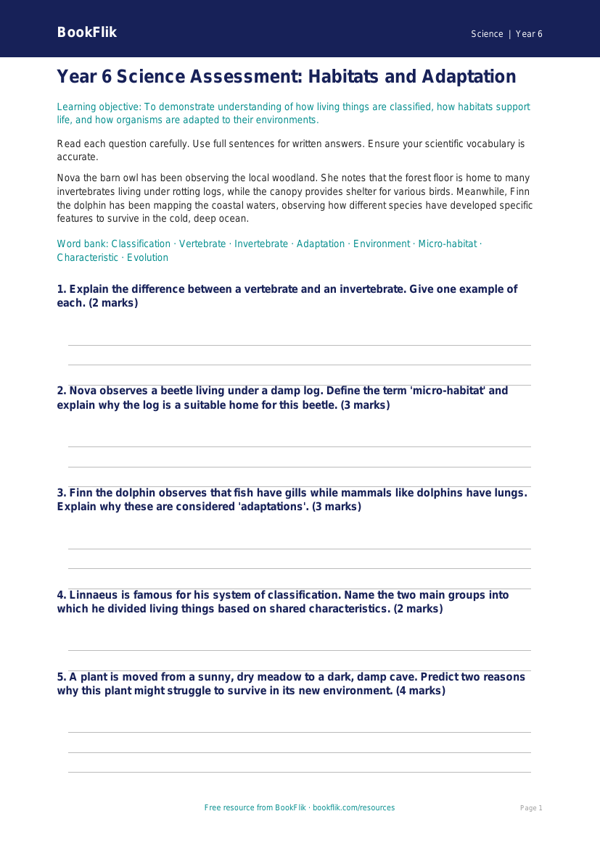
Looking for a reliable way to gauge your pupils’ understanding of ecosystems? Our free Science habitats assessment year 6 core resource is designed to help teachers evaluate pupil progress against the UK National Curriculum requirements for living things and their habitats.
In this comprehensive pack, our resident expert, Bea the honeybee, guides children through essential scientific concepts. Pupils will explore how living things are classified into broad groups according to common observable characteristics, including micro-organisms, plants, and animals. The assessment focuses on the key enquiry skills required at the end of Key Stage 2, ensuring that students can articulate how organisms are adapted to their environments and why these adaptations are vital for survival.
This Science habitats assessment year 6 core is perfectly aligned with the Year 6 curriculum, focusing on the classification of living things and the specific environmental factors that influence habitat health. Teachers can use this material as a diagnostic tool at the start of a topic, a formative check during lessons, or a summative assessment to identify gaps in knowledge.
Designed specifically for learners working at the expected standard, the resource includes 5 to 7 varied questions. These range from simple recall of scientific vocabulary to complex application tasks, such as explaining how a specific creature, like a fox or a bird, thrives in its local environment. By using this Science habitats assessment year 6 core, educators can provide clear, actionable feedback to help pupils excel in their scientific studies.
The document is provided in a ready-to-print format, making it easy to integrate into your weekly planning. With clear instructions and curriculum-linked questions, it serves as an excellent addition to your classroom toolkit, supporting both summative grading and daily classroom instruction. Download this resource today to help your Year 6 class master the fascinating world of habitats and classification.
Preview the worksheet
If the preview does not load, open the PDF in a new tab.