
Free Human Body Writing Frame | Year 5 Greater Depth | BookFlik
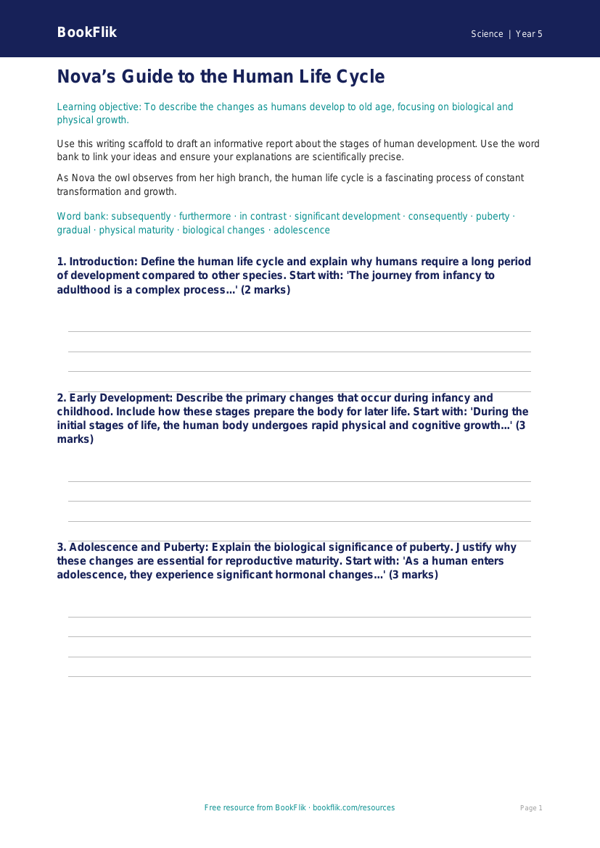
Unlock the wonders of human biology with our exclusive Science human body writing frame year 5 greater depth resource. Designed specifically for pupils who thrive on complex challenges, this writing frame moves beyond simple labelling to encourage deep, analytical thinking about our internal systems.
Our BookFlik character Nova the owl introduces this investigative pack, which is perfectly aligned with the UK National Curriculum requirements for Year 5. Pupils will explore the fascinating stages of human development, from infancy to old age, while applying scientific vocabulary to explain biological processes. This Science human body writing frame year 5 greater depth resource is ideal for teachers looking to push their high-achieving learners to synthesise information rather than just recalling facts.
The resource includes a structured template that guides students through critical thinking exercises. Instead of basic diagrams, learners are tasked with justifying why certain physical changes occur and comparing the biological needs of humans at different life stages. By using this Science human body writing frame year 5 greater depth material, educators can facilitate classroom discussions that require students to predict outcomes and evaluate evidence. It is a fantastic tool for independent research projects or as a scaffold for extended scientific report writing.
Inside, you will find six to eight challenging tasks, including:
1. Explain why the human body requires different nutrients as it matures from a toddler to an adult.
2. Compare and contrast the physical capabilities of a human at age five versus age seventy.
3. Justify your answer: Why is the process of ageing considered a natural biological progression?
4. What might happen if a human did not undergo the typical growth spurts during puberty?
5. Create a timeline illustrating the most significant physiological changes in the human life cycle.
6. Design an experiment to test reaction times across different age groups, justifying your chosen variables.
Download this resource today to inspire your young scientists to think critically about the incredible human machine.
Preview the worksheet
If the preview does not load, open the PDF in a new tab.