
Free Light Template | Year 5 Greater Depth | BookFlik
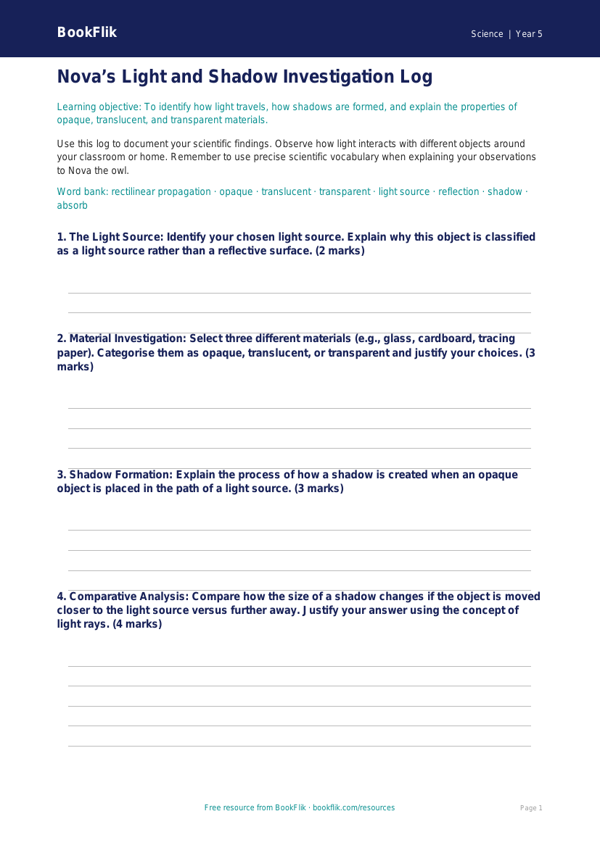
Unlock the mysteries of the spectrum with our comprehensive Science light template year 5 greater depth resource. Designed specifically for Year 5 pupils in UK primary schools, this pack provides an intellectually stimulating approach to the National Curriculum objective: recognising that light appears to travel in straight lines and understanding how we see objects.
In this lesson, our inquisitive barn owl, Nova, guides students through the physics of reflection, refraction, and the formation of shadows. Rather than simple fact-retrieval, this Science light template year 5 greater depth encourages learners to investigate the scientific principles behind periscopes, mirrors, and colour dispersion. By using this template, teachers can facilitate high-level classroom discussions that move beyond basic observation. The resource includes structured inquiry tasks, diagrammatic analysis, and experimental planning sheets that require pupils to apply their knowledge of light sources and opaque, translucent, and transparent materials to solve complex physical problems.
The differentiation is built directly into the questioning strategy. While core tasks ensure a solid grasp of the curriculum, the greater depth sections provide rigorous challenges for pupils exceeding age-related expectations. Students will be asked to justify their answers, predict outcomes of light-based experiments, and evaluate the accuracy of their scientific models.
Teachers can seamlessly integrate this Science light template year 5 greater depth into their weekly planning to support mastery-level learning. The pack is perfect for independent study or collaborative group work, ensuring every pupil is engaged with the wonders of optics.
Challenge your class to think like physicists with these thought-provoking questions:
1. Explain why shadows change size throughout the day as the sun moves across the sky.
2. Compare and contrast the way light behaves when hitting a mirror versus a piece of clear glass.
3. Justify your answer: Does light travel in waves or straight lines? Provide evidence.
4. What might happen if light did not travel in straight lines?
5. Design an experiment to prove that light reflects off surfaces at equal angles.
6. Create a creative poster explaining how the human eye perceives colour.
Preview the worksheet
If the preview does not load, open the PDF in a new tab.