
Free Living Things Poster | Year 6 Core | BookFlik
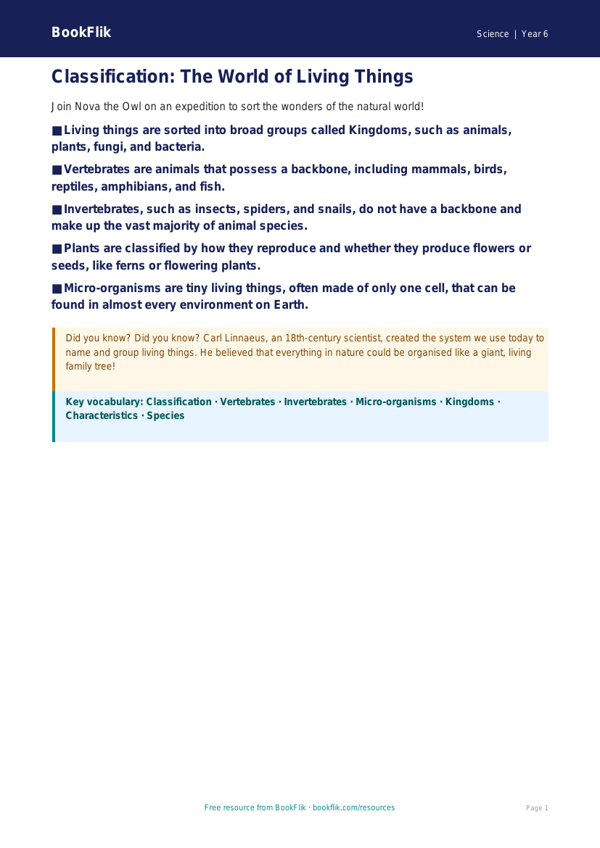
Brighten up your classroom with our vibrant Science living things poster year 6 core resource, designed to help pupils master the classification of organisms. This educational visual aid is perfect for teachers seeking a clear and engaging way to introduce the Linnaean system of classification. As children explore the natural world alongside Bea the honeybee, they will learn how to categorise living things into broad groups according to common observable characteristics, including microorganisms, plants, and animals.
Our Science living things poster year 6 core is aligned with the UK National Curriculum, specifically supporting the requirement for pupils to describe how living things are classified into broad groups according to common observable characteristics and based on similarities and differences. By using this resource, students will develop a deeper understanding of scientific nomenclature and the importance of classification in biology. It serves as an excellent reference point for classroom discussions and independent research projects.
Designed specifically for the expected standard of Year 6 learners, this poster balances detailed information with accessible, age-appropriate language. It is an ideal addition to any primary school science wall, helping to reinforce core curriculum concepts through clear illustrations and concise definitions. Whether you are introducing a new unit on evolution and inheritance or revising key biological concepts, this Science living things poster year 6 core provides the essential scaffolding students need to succeed.
To check understanding, the download includes five challenge questions:
1. What are the three main domains used to classify living things?
2. Why do scientists classify organisms into groups?
3. What are the key differences between vertebrates and invertebrates?
4. How do microorganisms differ from plants and animals?
5. If you discovered a new species, what features would you look for to classify it?
Download this resource today to transform your science lessons and inspire the next generation of biologists with Bea the honeybee.
Preview the worksheet
If the preview does not load, open the PDF in a new tab.