
Free Mixtures Writing Frame | Year 5 Greater Depth | BookFlik
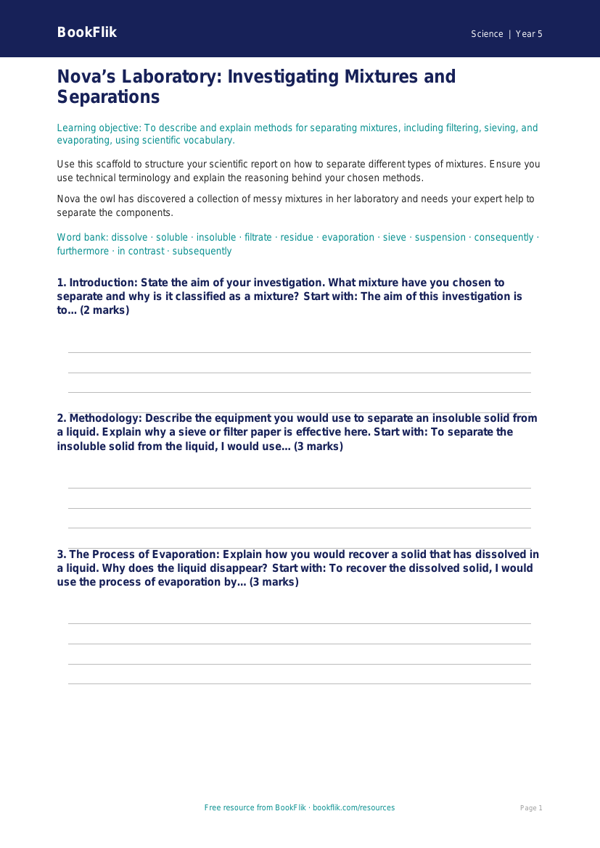
Mastering the separation of mixtures is a fundamental skill in the primary curriculum. Our Science mixtures writing frame year 5 greater depth resource is meticulously designed to support pupils in articulating their understanding of reversible and irreversible changes, as well as separation techniques such as filtering, sieving, and evaporation. By using this Science mixtures writing frame year 5 greater depth, students will move beyond simple observation and begin to construct scientific arguments based on empirical evidence gathered during practical investigations.
This resource features our inquisitive friend, Nova the barn owl, who guides students through complex scenarios. Rather than standard worksheets, this pack encourages children to hypothesise about particle behaviour and justify why specific methods are appropriate for separating different substances. The Science mixtures writing frame year 5 greater depth is perfectly aligned with the UK National Curriculum, specifically focusing on the properties and changes of materials. It encourages learners to use precise scientific vocabulary, such as solubility, residue, filtrate, and saturation, ensuring their written explanations are as rigorous as their experiments.
Teachers can utilise this tool to bridge the gap between practical laboratory work and formal scientific reporting. It is ideal for independent study or as a collaborative task for advanced learners who require a challenge beyond basic identification. The frame includes prompts that invite students to analyse variables and evaluate the effectiveness of their separation methods.
The resource includes 8 higher-order thinking questions, such as: Explain why evaporation is an effective method for recovering salt from a solution; Compare and contrast the processes of sieving and filtering; and What might happen if you attempted to separate a mixture of sand and iron filings using only water? This approach ensures that gifted and talented learners remain deeply engaged with the scientific process while developing the analytical writing skills necessary for success in upper Key Stage 2.
Preview the worksheet
If the preview does not load, open the PDF in a new tab.