
Free Rocks Flashcards | Year 4 Greater Depth | BookFlik
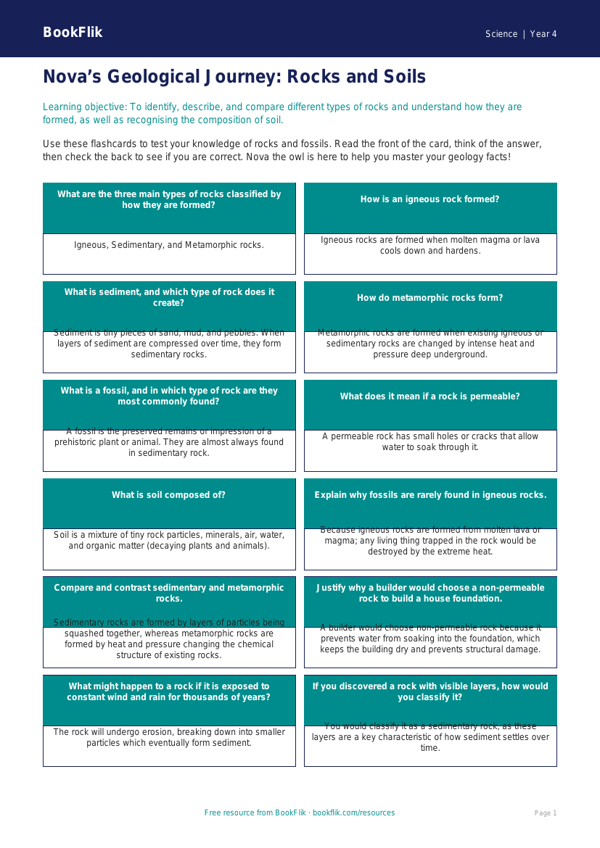
Boost your classroom engagement with our premium Science rocks flashcards year 4 greater depth resources, designed specifically to stretch high-achieving pupils. Understanding the formation and properties of rocks is a core component of the UK National Curriculum, and these materials move beyond basic definitions to encourage critical scientific enquiry.
By using these Science rocks flashcards year 4 greater depth, students will explore the distinct characteristics of igneous, sedimentary, and metamorphic rocks. Each card provides a springboard for deeper learning, asking pupils to classify samples, describe the process of fossilisation, and explain the permeability of various rock types. These resources are perfect for small-group rotations, independent investigations, or as a challenge-based extension activity for pupils who have already mastered the foundational concepts of the rock cycle.
Our collection includes eight thought-provoking questions tailored for greater depth learners. Students will be challenged to justify why specific rocks are chosen for construction, compare the cooling rates of intrusive and extrusive igneous rocks, and predict how environmental changes might alter geological formations over time. By incorporating these Science rocks flashcards year 4 greater depth, teachers can foster a classroom culture of enquiry and high-level analytical thinking.
These flashcards are versatile and can be used as a starter activity to activate prior knowledge or as a plenary to assess complex understanding. Whether your pupils are examining the texture of granite or the layered structure of sedimentary rock, these cards provide the vocabulary and conceptual framework needed to succeed. The set includes:
1. Explain why sedimentary rocks are the most likely to contain fossils.
2. Compare and contrast the formation of igneous and metamorphic rocks.
3. Justify why limestone is often used in building materials.
4. What might happen to a rock if it is subjected to immense pressure?
5. Describe the relationship between crystal size and cooling time in igneous rocks.
6. Create an original diagram illustrating the rock cycle.
7. How does weathering affect the surface appearance of a rock?
8. Analyse how the properties of slate make it suitable for roofing.
Preview the worksheet
If the preview does not load, open the PDF in a new tab.