
Free Skeleton And Muscles Assessment | Year 5 Greater Depth | BookFlik
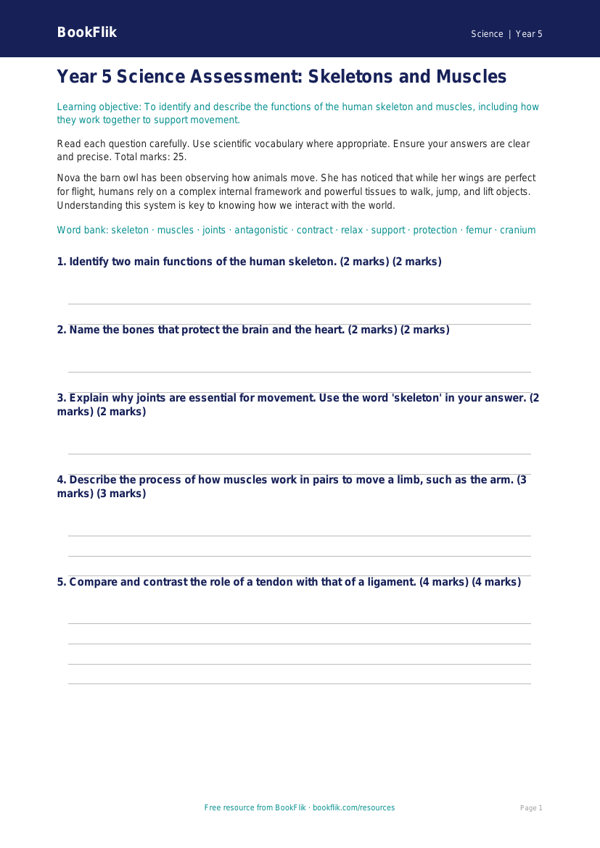
Boost your classroom impact with our comprehensive Science skeleton and muscles assessment year 5 greater depth resource. Designed specifically for ambitious learners in Key Stage 2, this pack moves beyond basic labelling to explore the sophisticated mechanics of the human musculoskeletal system.
As pupils progress through the Year 5 Science curriculum, it is vital to stretch those who demonstrate an advanced understanding. This Science skeleton and muscles assessment year 5 greater depth resource requires students to apply their knowledge to complex scenarios, such as analysing the role of antagonistic muscle pairs and evaluating how different skeletal structures provide protection and support. By using this Science skeleton and muscles assessment year 5 greater depth, teachers can effectively identify pupils who are ready for the challenge of deeper scientific enquiry.
The materials feature our original character, Nova the owl, who guides pupils through rigorous questioning. Children will investigate the synergy between joints, tendons, and ligaments, ensuring they meet the statutory requirements of the UK National Curriculum while developing critical thinking skills. This resource is perfect for formative assessment, allowing educators to gauge depth of understanding through high-order tasks rather than simple recall.
This pack includes 8 challenging questions, including:
1. Explain why the bicep and tricep must work as an antagonistic pair to facilitate movement.
2. Compare and contrast the function of a ball-and-socket joint with a hinge joint.
3. Justify your answer: Why is a rigid skeleton essential for a mammal’s survival?
4. What might happen if humans lacked a skeletal system? Describe the impact on internal organs.
5. Analyse the relationship between muscle contraction and bone movement.
6. Create a diagram showing how a prosthetic limb might mimic human muscle action.
7. Predict the long-term effects on the skeleton if a person maintained a sedentary lifestyle.
8. Design an experiment to test the reaction time of different muscle groups.
Download this free resource today to inspire your most inquisitive young scientists.
Preview the worksheet
If the preview does not load, open the PDF in a new tab.