
Free Sound Drawing Sheet | Year 6 Core | BookFlik
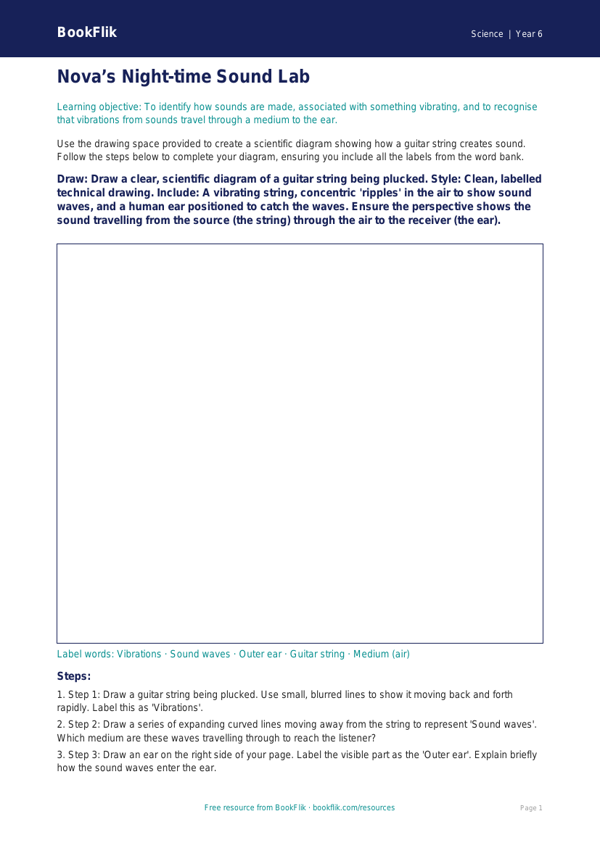
Boost your classroom engagement with our free Science sound drawing sheet year 6 core resource. Designed specifically for Year 6 pupils, this activity helps students visualise the invisible mechanics of acoustics. As children progress through their primary education, understanding how sound travels is a key requirement of the UK National Curriculum. This worksheet encourages learners to draw and label the vibrations of sound waves as they travel from a source to the human ear.
Our Science sound drawing sheet year 6 core is perfect for teachers looking to bridge the gap between abstract physics concepts and creative expression. By illustrating how vibrations cause particles to collide, students can better grasp the relationship between pitch, volume, and frequency. This resource is tailored for learners working at the expected standard, ensuring the difficulty level is perfectly pitched for 10 and 11-year-olds. Whether used as a starter activity to assess prior knowledge or as a plenary to consolidate learning after a practical experiment, it provides a clear, structured way for pupils to demonstrate their understanding.
The Science sound drawing sheet year 6 core includes 6 engaging tasks. First, children will define a sound source and identify how vibrations move through different states of matter. They will then label a diagram of the ear to show how sound waves are received. Finally, they will apply their knowledge by explaining why sound cannot travel through a vacuum. This activity is a fantastic way to ensure your science lessons are interactive and memorable.
This printable resource includes:
1. Identify the source: Label common objects that produce sound.
2. Wave illustration: Draw how sound travels through air particles.
3. Anatomy check: Label the main parts of the ear.
4. Pitch challenge: Explain the difference between high and low-frequency waves.
5. Volume application: Describe the link between amplitude and loudness.
6. Scientific reasoning: Explain why sound travels faster in solids than in gases.
Preview the worksheet
If the preview does not load, open the PDF in a new tab.