
Free Space Drawing Sheet | Year 5 Greater Depth | BookFlik
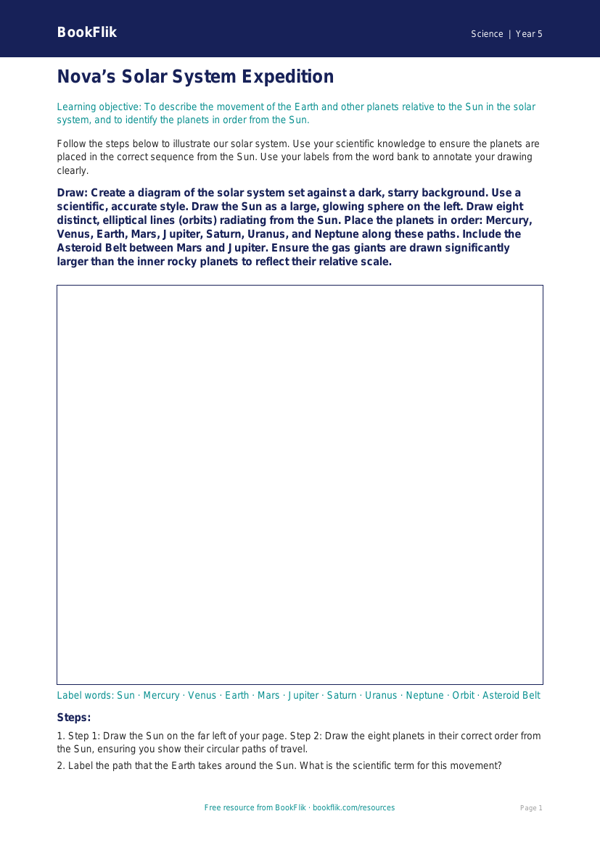
Inspire your pupils to reach for the stars with our premium Science space drawing sheet year 5 greater depth resource. Designed specifically for the UK National Curriculum, this activity invites students to move beyond simple labelling and engage with the complex mechanics of our solar system.
In this lesson, our friend Nova the owl guides children through the wonders of the cosmos. As pupils complete this Science space drawing sheet year 5 greater depth, they will illustrate the relative positions of the planets, demonstrate their understanding of planetary orbits, and explain the geocentric versus heliocentric models of the universe. This resource is perfect for classroom displays or as a formative assessment tool to gauge a student’s grasp of Earth and space.
What makes this resource ideal for high-achieving learners is its focus on critical thinking. Rather than just memorising facts, children are challenged to justify their scientific reasoning. By using this Science space drawing sheet year 5 greater depth, teachers can easily differentiate their lessons; the sheet provides a scaffolded approach for core learners while offering sophisticated extension tasks for those ready to delve deeper into astrophysics concepts.
Extension Questions for Greater Depth:
1. Explain why the distance between planets affects the time it takes for them to complete a full orbit around the Sun.
2. Compare and contrast the characteristics of the inner rocky planets with the outer gas giants.
3. Justify your answer: Why do we experience day and night on Earth, and how would this change if the Earth’s rotation speed doubled?
4. What might happen if the Sun’s gravitational pull were significantly weaker?
5. Illustrate the moon’s phases and explain the relationship between the Sun, Earth, and Moon.
6. Design a hypothetical planet; describe its orbit, temperature, and atmospheric composition based on its distance from a star.
Download this resource today to foster scientific curiosity and artistic expression in your Year 5 classroom.
Preview the worksheet
If the preview does not load, open the PDF in a new tab.