
Free Spring Science Writing Frame | Year 5 Greater Depth | BookFlik
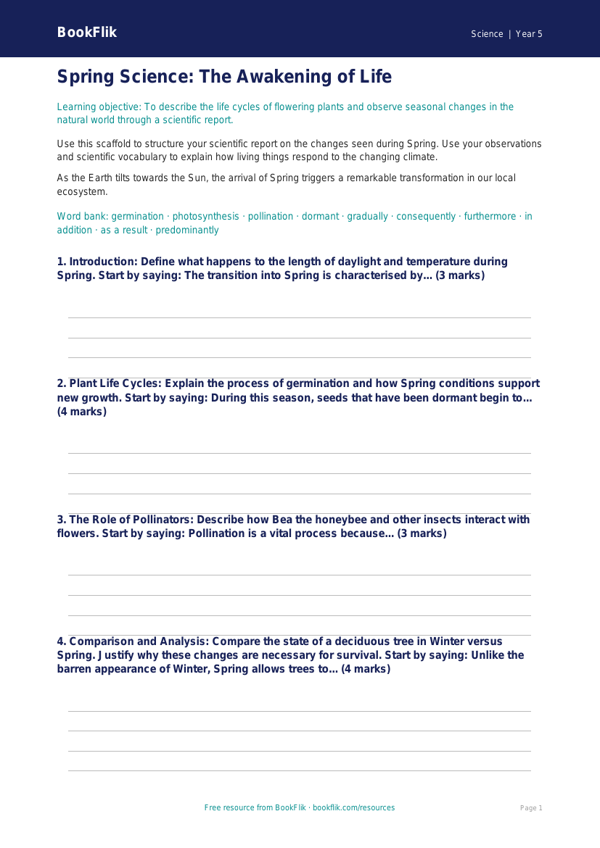
Elevate your classroom teaching with our expertly crafted Science spring science writing frame year 5 greater depth resource. Designed specifically for ambitious learners who thrive on challenge, this writing frame encourages pupils to move beyond simple observation and into the realm of scientific enquiry and formal report writing.
As the natural world awakens, our friend Bea the honeybee invites students to explore the intricate life cycles, plant reproduction, and seasonal changes characteristic of the vernal equinox. This Science spring science writing frame year 5 greater depth is aligned with the UK National Curriculum, specifically supporting the ‘Living things and their habitats’ and ‘Plants’ units. By utilising this frame, pupils will develop their ability to use scientific vocabulary, construct complex sentences, and present evidence-based conclusions.
Teachers can use this resource as a scaffold for independent investigations or as a stimulus for a comparative study between spring and autumn ecosystems. The structure is intentionally open-ended, pushing gifted and talented learners to justify their observations through biological reasoning. Because this is a Science spring science writing frame year 5 greater depth, it includes specific prompts for higher-order thinking, such as evaluating the impact of temperature on germination rates and predicting the consequences of environmental shifts on local pollinators.
The resource features six to eight challenging tasks, including:
1. Explain why specific environmental triggers are necessary for the onset of spring blooming.
2. Compare and contrast the reproductive strategies of two distinct local plant species.
3. Justify your answer regarding why certain insects emerge earlier than others.
4. What might happen if the spring season were delayed by three weeks?
5. Create a hypothesis regarding the relationship between daylight hours and plant growth.
6. Design a mini-experiment to test the effect of soil pH on spring bulb development.
Download this professional resource today to inspire your young scientists to think critically, write precisely, and explore the wonders of the natural world with academic rigour.
Preview the worksheet
If the preview does not load, open the PDF in a new tab.