
Free States Of Matter Writing Frame | Year 5 Greater Depth | BookFlik
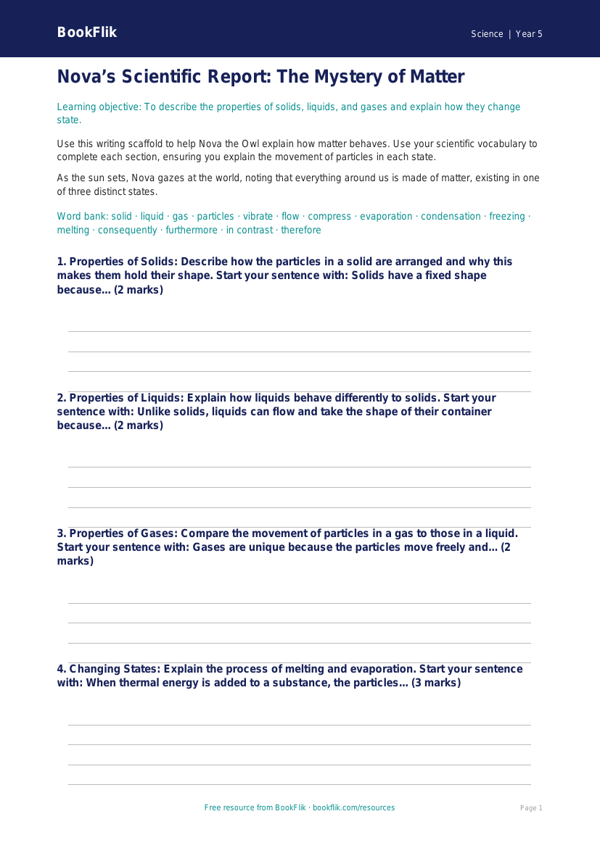
Unlock the fascinating world of particles with our Science states of matter writing frame year 5 greater depth resource. Designed specifically for Year 5 pupils working at a higher level of attainment, this structured writing tool encourages children to move beyond basic definitions and explore the complex kinetic theory behind solids, liquids, and gases.
Aligned with the UK National Curriculum, this resource supports students in explaining how particles behave in different states. Instead of simple labelling, our Science states of matter writing frame year 5 greater depth prompts pupils to justify why a substance changes state when heated or cooled. It includes sections for scientific diagrams, particle model analysis, and high-level vocabulary such as condensation, evaporation, and sublimation.
Teachers can use this resource as a core assessment tool during a laboratory investigation or as a consolidation task following a lesson on reversible changes. Because this is a Science states of matter writing frame year 5 greater depth resource, it features open-ended prompts that challenge pupils to apply their knowledge to real-world scenarios. For example, learners might be asked to justify why an ice lolly melts faster on a sunny day or compare the compressibility of gas particles against the rigidity of solids.
The frame includes 8 distinct tasks:
1. Explain why the arrangement of particles in a solid prevents it from flowing.
2. Compare and contrast the movement of particles in a liquid versus a gas.
3. Justify your answer: Does the mass of a substance change when it melts?
4. What might happen if the internal energy of a liquid were suddenly removed?
5. Describe the process of evaporation using the particle model.
6. Analyse a scenario where a gas is compressed into a container.
7. Design a hypothesis for an experiment involving freezing points.
8. Creative Extension: Write a poem from the perspective of an excited particle transitioning from a liquid to a gas.
Preview the worksheet
If the preview does not load, open the PDF in a new tab.