
Free Family Drawing Sheet | Year 5 Greater Depth | BookFlik
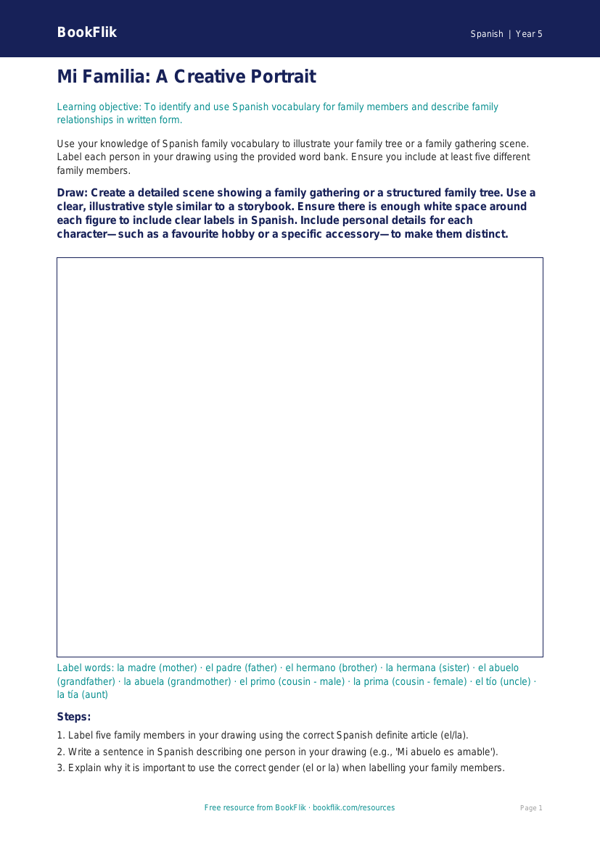
Boost your classroom resources with our engaging Spanish family drawing sheet year 5 greater depth. Designed specifically for Year 5 pupils working at a higher level of attainment, this educational tool combines creative expression with language acquisition. As pupils illustrate their own family trees, they will consolidate their knowledge of Spanish kinship vocabulary, including terms like abuelo, hermano, and primo, while practising possessive adjectives such as mi and sus.
Teachers can use this Spanish family drawing sheet year 5 greater depth to facilitate a bridge between visual art and linguistic mastery. By moving beyond simple vocabulary lists, pupils are encouraged to construct complex sentences describing their family members’ roles, ages, and interests. This resource aligns perfectly with the UK National Curriculum objective of enabling pupils to express their ideas and opinions in speech and writing, while developing an appreciation for the structure of a foreign language.
The differentiation within this pack provides a significant challenge for gifted and talented learners. Rather than basic labelling, children are prompted to write detailed paragraphs in Spanish, using conjunctions and descriptive adjectives to provide context about their relatives. By integrating this Spanish family drawing sheet year 5 greater depth into your MFL lessons, you provide an opportunity for pupils to demonstrate their mastery of verb conjugations and sentence expansion.
Our characters, including the bilingual parrot Rosa, guide the students through these tasks with encouraging prompts. Beyond the core vocabulary, the extension activities challenge pupils to reflect on cultural differences in family structures and justify their choices in their written descriptions. Use these tasks to inspire deeper thinking:
1. Explain why you chose specific adjectives to describe your family members.
2. Compare and contrast your family structure with a typical Spanish-speaking household.
3. Justify your use of formal versus informal terms for different relatives.
4. What might happen if you had to describe an extended family tree using only third-person pronouns?
5. Create a short poem in Spanish about a family member.
6. Design a new family tree layout that categorises relatives by their hobbies rather than just their titles.
Preview the worksheet
If the preview does not load, open the PDF in a new tab.