
Free Telling The Time Flashcards | Year 5 Greater Depth | BookFlik
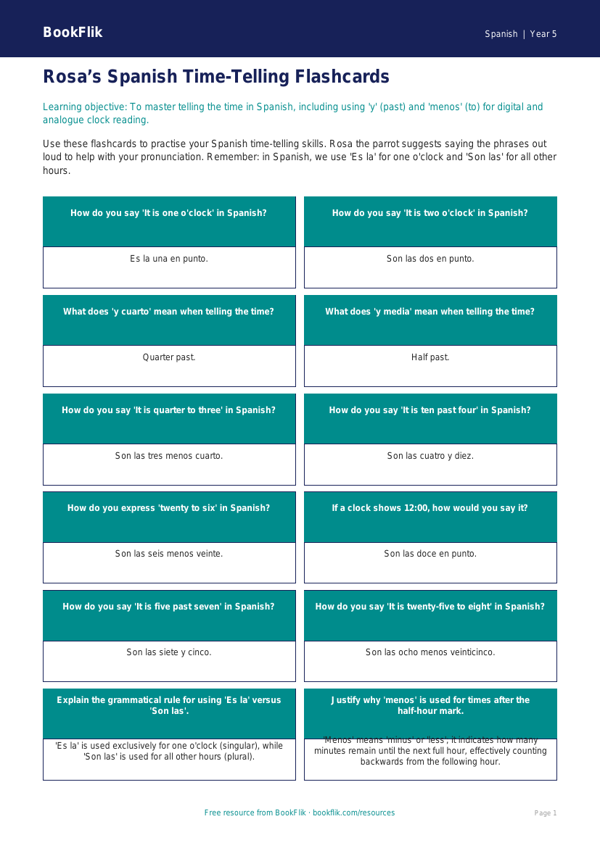
Mastering the nuances of telling the time in a foreign language is a key milestone for pupils in upper Key Stage 2. Our premium Spanish telling the time flashcards year 5 greater depth resource is meticulously crafted to support the UK National Curriculum, specifically focusing on building confidence in spoken and written Spanish. These resources help pupils move beyond simple hour-telling, encouraging them to construct complex sentences involving half-hours, quarters, and specific minutes past or to the hour.
Our Spanish telling the time flashcards year 5 greater depth pack features vibrant illustrations and clear, academic phrasing to ensure students grasp the grammatical structures of using es la and son las. Teachers can utilise these in small groups for rapid-fire drills, or as a sophisticated matching game where pupils must pair digital times with their written Spanish equivalents. Because this set is designed for greater depth, it includes cards that challenge learners to incorporate connectives and time-related vocabulary, such as de la mañana, de la tarde, and de la noche.
By integrating these Spanish telling the time flashcards year 5 greater depth materials into your daily routine, you provide gifted and talented students with the opportunity to refine their linguistic accuracy and expand their vocabulary. This resource is perfect for extension activities, peer-led learning, or as a self-directed challenge for those who have mastered the foundational basics.
Reflective Questions for Greater Depth:
1. Explain why we use son las for most hours but es la for one o’clock in Spanish.
2. Compare and contrast the way we express minutes past the hour in English versus Spanish.
3. Justify why it is important to include de la tarde when stating the time in a formal context.
4. What might happen if you misidentify the quarter-past and quarter-to markers?
5. How would you explain the phrase y media to a peer struggling with the concept?
6. Create an original schedule for a day in the life of Rosa the parrot, detailing three specific events using complex time phrases.
Preview the worksheet
If the preview does not load, open the PDF in a new tab.