
Free Telling The Time Word Mat | Year 5 Greater Depth | BookFlik
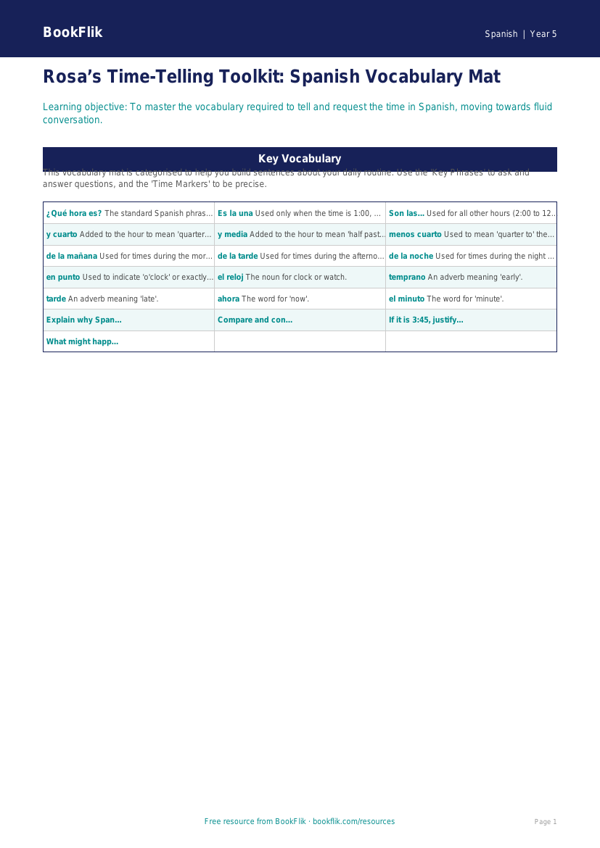
Master the art of Spanish timekeeping with our comprehensive resource designed specifically for your classroom. This Spanish telling the time word mat year 5 greater depth is the perfect tool to help pupils move beyond basic hourly increments and explore complex temporal structures in Spanish. Aligned with the UK National Curriculum for languages at Key Stage 2, this resource encourages children to articulate time using fractions, such as quarter past (y cuarto) and half past (y media), while introducing the more challenging concept of subtracting minutes from the hour (menos).
Our Spanish telling the time word mat year 5 greater depth is crafted for high-attaining learners who are ready to expand their vocabulary. By providing clear visual prompts and essential grammatical structures, the mat allows students to construct full, accurate sentences in Spanish. Teachers can utilise this resource to facilitate pair-work speaking activities, where pupils take turns asking and answering questions about their daily schedules, fostering fluency and confidence.
Beyond simple translation, this Spanish telling the time word mat year 5 greater depth provides the necessary scaffolding for pupils to engage with higher-order thinking tasks. The inclusion of advanced vocabulary and irregular verb forms ensures that gifted and talented learners remain sufficiently challenged.
To extend learning, we have included eight rigorous questions designed to deepen linguistic comprehension:
1. Explain why we use ‘es la’ for one o’clock but ‘son las’ for all other hours.
2. Compare and contrast the way we express ‘twenty-five to’ in English and Spanish.
3. Justify why it is important to understand the 24-hour clock when travelling in Spain.
4. What might happen if a speaker forgets to use the definite article when stating the time?
5. Translate the following sentence into Spanish: ‘It is ten to eight in the evening.’
6. Create a schedule for your perfect day entirely in Spanish.
7. How does the structure of telling time change when using the digital versus analogue format?
8. If a train departs at 14:45, how would you express this duration using the ‘menos’ structure?
Preview the worksheet
If the preview does not load, open the PDF in a new tab.