
Free Monet Worksheet | Grade 3 | Art | BookFlik
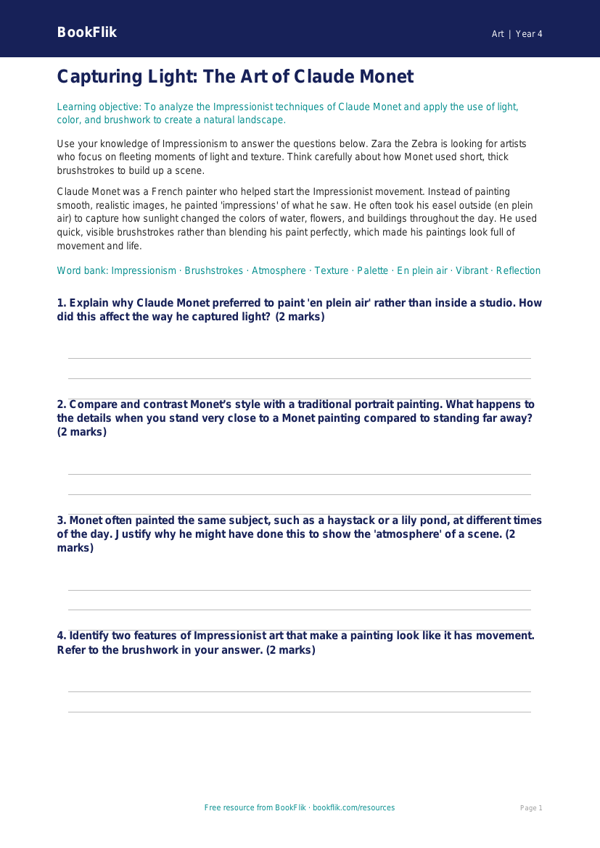
Bring the vibrant world of Impressionism into your classroom with our exclusive Art Monet worksheet year 4 greater depth resource. Designed specifically for pupils who are ready to move beyond basic observation, this pack invites children to explore the revolutionary techniques of Claude Monet. Our friendly character, Zara the zebra, guides students through the fascinating way Monet used short, thick brushstrokes to capture the fleeting essence of light and atmosphere.
This Art Monet worksheet year 4 greater depth material aligns perfectly with the Common Core State Standards goal of improving mastery of art and design techniques, including drawing, painting, and sculpture with a range of materials. Students will not only learn about color theory and the juxtaposition of complementary colors but will also be encouraged to think critically about the artist’s intent. By studying works like the Water Lilies series, learners will develop a deeper appreciation for how artists record the natural world.
Teachers can use this resource as a standalone lesson or as part of a broader unit on the history of art. The differentiation is carefully embedded, ensuring that advanced learners are pushed to analyze, interpret, and justify their creative choices. With tasks ranging from detailed observational sketching to writing a reflective critique, this Art Monet worksheet year 4 greater depth resource caters to high-achieving students who thrive on complexity.
The worksheet includes six to eight challenging questions that move from factual recall to higher-order thinking, such as explaining the impact of light on a landscape and justifying why Monet chose specific palettes for different times of the day. We have also included a creative extension task that asks pupils to imagine a modern scene through the eyes of an Impressionist painter. Download this high-quality, educator-approved resource today to inspire your Grade 3 class and foster a lasting passion for art history and creative expression in every pupil.
Preview the worksheet
If the preview does not load, open the PDF in a new tab.