
Free Programming Template | Grade 3 | Computing | BookFlik
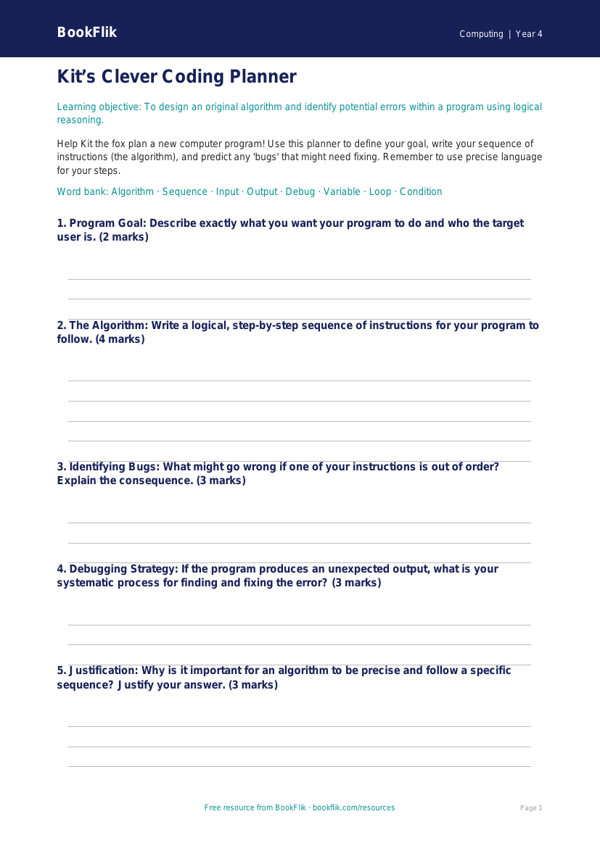
Unlock the potential of your young coders with our bespoke Computing programming template year 4 greater depth resource. Designed specifically for Grade 3 pupils who require more rigorous challenges, this digital pack moves beyond basic sequencing. It provides a structured yet open-ended framework for students to design, write, and debug their own interactive algorithms. By using this Computing programming template year 4 greater depth, teachers can facilitate lessons that align perfectly with the Common Core State Standards, focusing on logical reasoning, variables, and decomposition.
The resource features Kit, our clever fox, who guides students through complex problem-solving tasks. Pupils will explore how to use sequence, selection, and repetition in programs, working with logical operators to create more sophisticated digital outcomes. This Computing programming template year 4 greater depth allows educators to differentiate seamlessly; while core tasks build foundational knowledge, the extension activities invite pupils to justify their code choices and predict the outcomes of nested loops.
This template is ideal for teachers looking to stretch their gifted and talented learners. It encourages children to move past simple trial and error, instead fostering a systematic approach to debugging. The activities are mapped to the Elementary Computing program of study, ensuring that pupils develop the computational thinking required for higher-level primary education.
Included in the pack are six higher-order thinking questions designed to challenge pupils:
1. Explain why a specific sequence of code might fail to produce the intended output.
2. Compare and contrast the efficiency of two different algorithms that achieve the same result.
3. Justify your decision to use a loop rather than repeating a sequence of commands.
4. What might happen if a variable in your program is changed mid-sequence?
5. Predict the behavior of a program if one logical operator is replaced with another.
6. Create an original program that solves a real-world problem, such as calculating the cost of items at a store in dollars and cents.
Preview the worksheet
If the preview does not load, open the PDF in a new tab.