
Free Pitch Flashcards | Grade 3 | Music | BookFlik
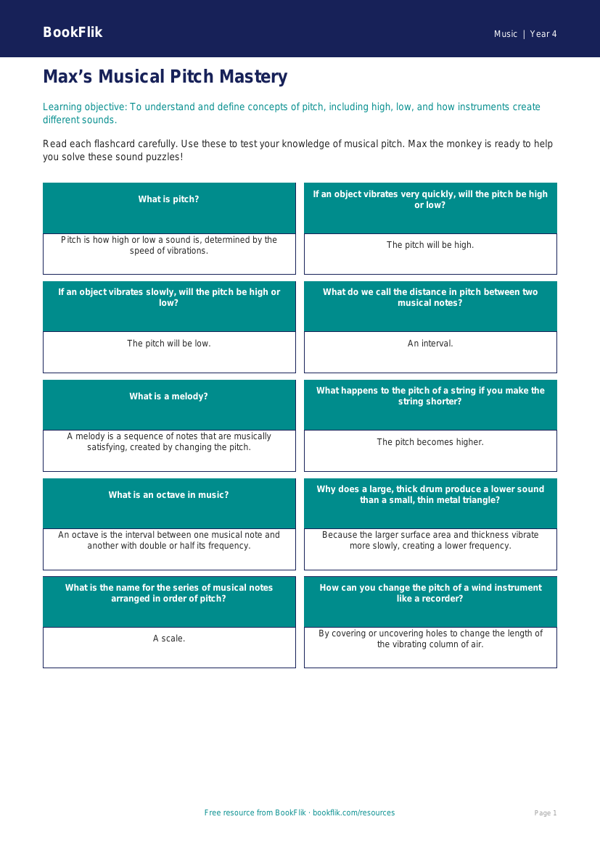
Boost your classroom music lessons with our comprehensive Music pitch flashcards year 4 greater depth resource. Designed specifically for Elementary pupils, these materials move beyond basic definitions to explore the complex relationship between frequency, vibration, and musical notation.
What will children learn?
Pupils will gain a sophisticated understanding of how pitch is determined by the length and tension of an instrument’s strings or the size of a resonant chamber. By using these Music pitch flashcards year 4 greater depth, students will master terminology such as frequency, oscillation, and intervals, allowing them to explain how pitch varies across different families of instruments, including percussion, woodwind, and brass.
How to use these resources:
These cards are perfect for small group interventions or independent challenge stations. Teachers can use them to facilitate peer-to-peer quizzing, or as a starting point for scientific investigations into sound waves. The pack includes scaffolded prompts that encourage pupils to link their musical knowledge to their science curriculum, making it an excellent cross-curricular tool.
Common Core State Standards alignment:
This set aligns perfectly with the Grade 3 music program of study, which requires children to play and perform in solo and ensemble contexts using their voices and instruments with increasing accuracy, fluency, control, and expression. Furthermore, it supports the science curriculum objective of identifying how sounds are made and associating some of them with something vibrating.
Differentiation for greater depth:
This set is specifically crafted for gifted and talented learners who require more than just rote learning. Featuring higher-order thinking questions, these Music pitch flashcards year 4 greater depth challenge students to justify their musical choices, compare the physics of different instruments, and predict how altering physical dimensions changes the sound produced. With prompts that ask pupils to explain why certain notes sound harmonious or dissonant, this resource ensures that even your most advanced learners remain engaged, curious, and challenged throughout your music lessons.
Preview the worksheet
If the preview does not load, open the PDF in a new tab.