
Free Classification Keys Poster | Grade 3 | Science | BookFlik
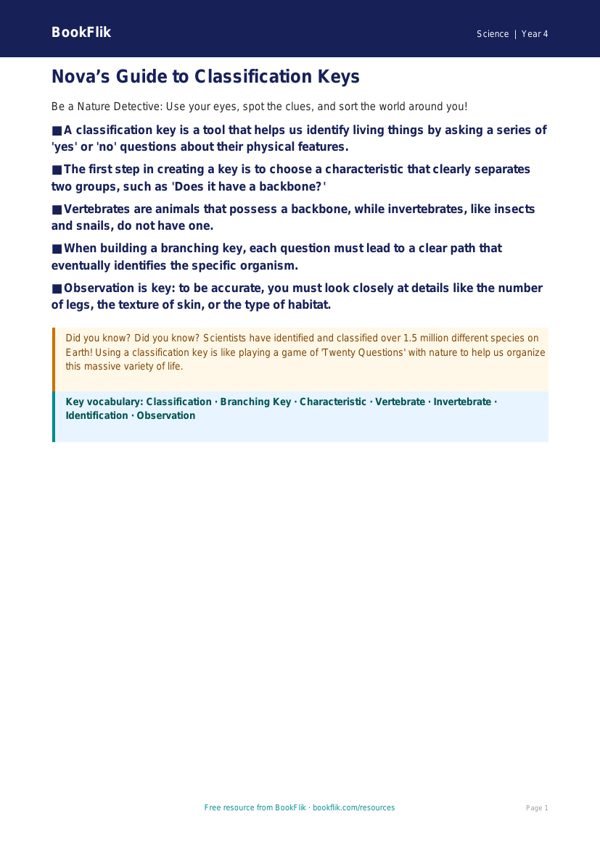
Boost your primary classroom science display with our engaging and intellectually stimulating Science classification keys poster year 4 greater depth. Designed specifically for Grade 3 pupils who are ready to move beyond basic identification, this educational resource bridges the gap between simple observation and rigorous scientific inquiry.
This vibrant poster features our resident expert, Bea the honeybee, who guides learners through the logical structure of branching databases. Pupils will learn how to transition from identifying common garden minibeasts to creating their own complex, multi-step classification keys. By examining the structural characteristics of diverse organisms, children will develop the essential skills required to categorize living things based on specific, observable traits.
Teachers can use this Science classification keys poster year 4 greater depth as a focal point for whole-class investigations or as a reference tool during independent research projects. It perfectly aligns with the Common Core State Standards objective for Grade 3 Science, which requires pupils to recognize that living things can be grouped in a variety of ways.
What sets this resource apart is its focus on greater depth learning. We have included a section that challenges gifted and talented learners to justify their reasoning when selecting criteria for their keys. Instead of just identifying an animal, students are prompted to explain why certain physical characteristics are more effective for classification than others.
The resource includes six high-order thinking questions, such as: Explain why a classification key might become less effective if the criteria are too subjective; Compare and contrast the methods used to classify vertebrates versus invertebrates; and What might happen if a new species is discovered that does not fit into any existing branches of your key?
Download this Science classification keys poster year 4 greater depth today to inspire your young scientists to think critically, analyze patterns, and master the fundamental principles of biological classification.
Preview the worksheet
If the preview does not load, open the PDF in a new tab.