
Free Electricity Word Mat | Grade 3 | Science | BookFlik
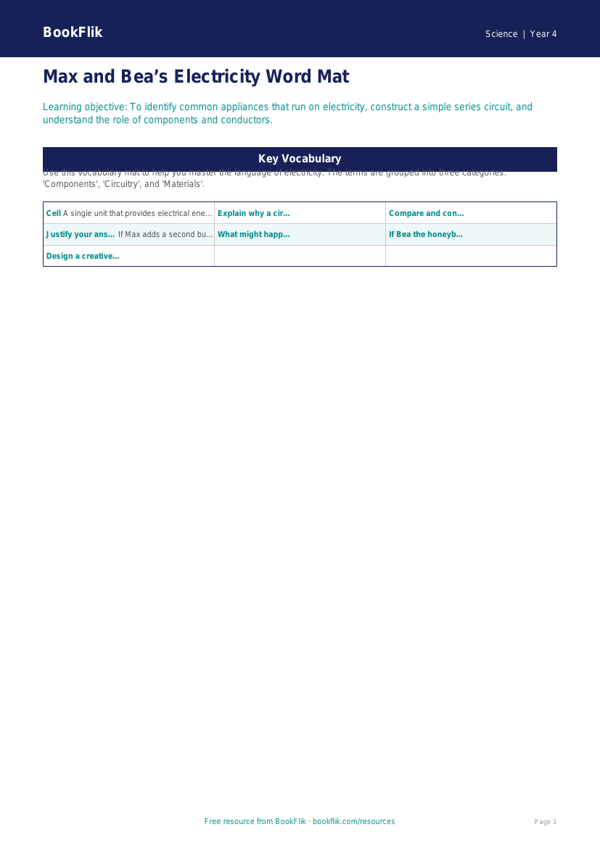
Boost your classroom resources with our comprehensive Science electricity word mat year 4 greater depth, specifically designed to challenge high-achieving pupils. This premium educational tool is an essential addition for any primary school teacher looking to stretch their learners beyond the standard curriculum requirements.
Our Science electricity word mat year 4 greater depth covers key vocabulary including conductors, insulators, complete circuits, voltage, and electrical components. Unlike standard mats, this version incorporates advanced terminology such as resistance, current flow, and energy transformation, ensuring that students who are exceeding age-related expectations remain fully engaged. By providing this Science electricity word mat year 4 greater depth, you are supporting pupils in articulating complex scientific concepts with precision and confidence.
The resource is fully aligned with the Common Core State Standards for Grade 3, which expects children to identify common appliances, construct simple series circuits, and understand the role of switches. To support greater depth, we have included a section on the historical evolution of electricity, encouraging learners to consider the impact of innovators like Michael Faraday. Teachers can use this mat during independent research tasks, as a scaffold for written explanations, or as a prompt for inquiry-based discussions.
The included questions are specifically engineered for higher-order thinking. Pupils are challenged to:
1. Explain why certain materials are chosen for electrical cables based on their properties as conductors.
2. Compare and contrast the function of a switch in a series circuit with a control mechanism in a home appliance.
3. Justify why a circuit might fail to work if a component is faulty or connected incorrectly.
4. What might happen if an insulator were used to connect a battery to a bulb?
5. Analyze the difference between a cell and a battery.
6. Design a complex circuit diagram and predict the brightness of multiple bulbs.
7. Create a flow chart illustrating the path of electricity from a power station to a home.
Download this resource today to inspire your young scientists to think critically about the energy that powers our world.
Preview the worksheet
If the preview does not load, open the PDF in a new tab.