
Free Skeleton And Muscles Quiz | Grade 3 | Science | BookFlik
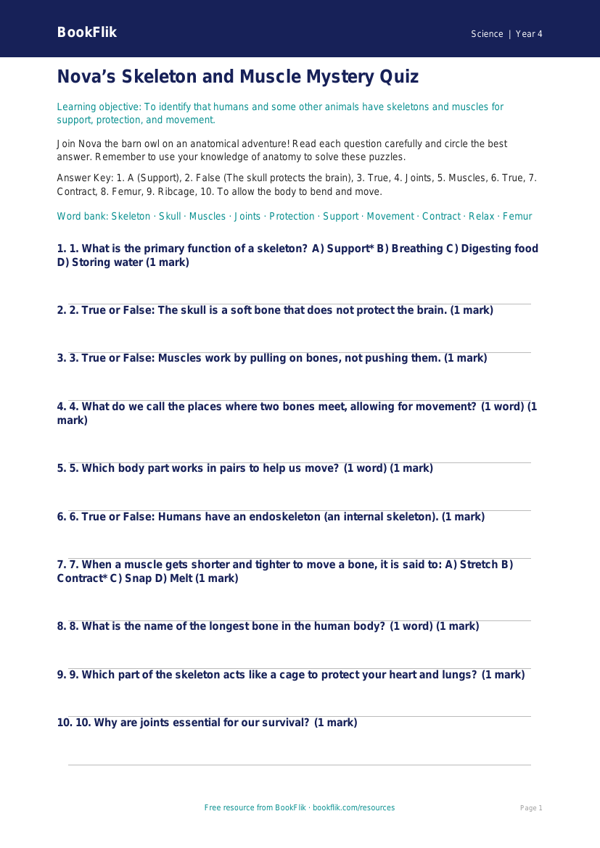
Are you looking for a challenging way to extend your pupils’ understanding of biology? Our Science skeleton and muscles quiz year 4 greater depth resource is designed specifically for high-attaining learners who are ready to move beyond basic labelling. This high-quality, free educational pack invites children to join Max the monkey, who thinks everything is a complex puzzle, as he explores the mechanical marvels of the human body.
Aligned with the Common Core State Standards, this resource focuses on the roles of the human skeleton and muscular system. While standard tasks might ask students to identify a femur or a bicep, this Science skeleton and muscles quiz year 4 greater depth encourages pupils to analyze the interplay between anatomy and movement. Through a series of rigorous questions, students will explore the structural importance of joints, the protective function of the ribcage, and the antagonistic relationship between muscle pairs.
Teachers can use this versatile resource as a formative assessment tool to identify pupils who require further intellectual stimulation, or as a collaborative challenge for mixed-ability groupings. The materials are meticulously crafted to foster critical thinking, requiring students to justify their scientific reasoning rather than simply recalling facts. By incorporating the Science skeleton and muscles quiz year 4 greater depth, you ensure your classroom environment supports those exceeding age-related expectations.
This pack includes six to eight complex questions, featuring open-ended prompts such as: Explain why the human skeleton would be ineffective if it were made of a single solid bone, and justify your answer using your knowledge of joints. Another creative task invites students to imagine a scenario where a specific muscle group ceases to function, asking them to describe the impact on daily movement. Encourage your Grade 3 scientists to think deeply, reason logically, and master the fascinating mechanics of the human frame today.
Preview the worksheet
If the preview does not load, open the PDF in a new tab.