
Musical Elements Template | Year 4 Music | Australian Curriculum
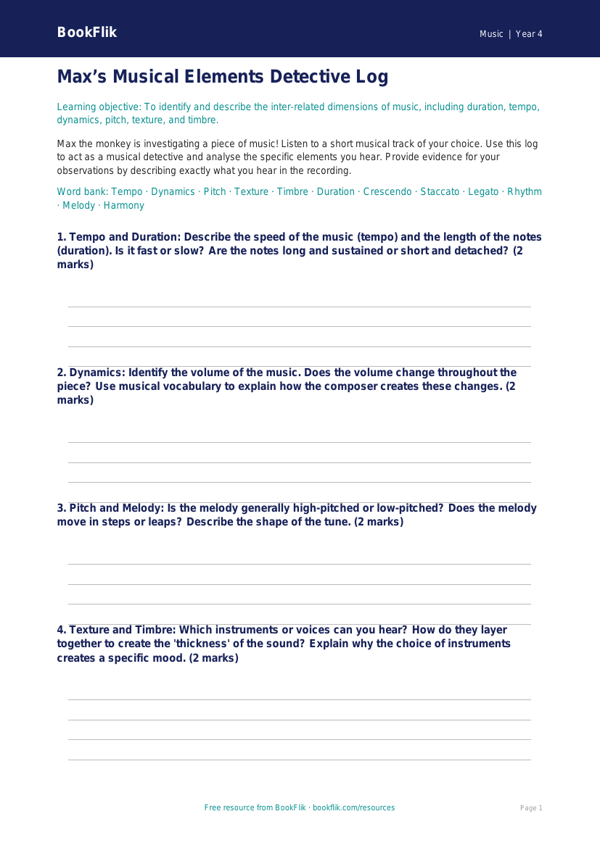
Unlock your pupils’ potential with our comprehensive music musical elements template year 4 greater depth resource. Designed specifically for Year 4 classrooms, this educational pack helps children explore the fundamental components of composition and performance, including pitch, duration, dynamics, tempo, timbre, texture, and silence.
By using this music musical elements template year 4 greater depth, students will move beyond basic identification and begin to analyse how composers manipulate these elements to evoke specific emotions or tell stories. The resource aligns perfectly with the Australian Curriculum (ACARA) for Key Stage 2, which requires pupils to improvise and compose music for a range of purposes.
Our original character, Zara the zebra, guides students through the activities. Zara, who sees art and patterns everywhere, encourages learners to look for the structural beauty in sound. The pack is structured to support teachers in delivering high-quality music lessons, providing clear frameworks for evaluating both their own compositions and the works of others.
What makes this resource truly special is its focus on higher-order thinking. While standard tasks ask pupils to identify a loud or soft sound, the greater depth challenges require students to justify their choices. For example, learners must explain why a composer might choose a staccato texture to represent movement or compare the impact of tempo changes on the listener’s mood.
The music musical elements template year 4 greater depth includes six rigorous questions designed to stretch gifted and talented learners. These tasks encourage children to justify their creative decisions, compare different musical styles, and predict the impact of changing specific variables within a composition. Whether you are a music specialist or a class teacher, this template provides a robust, professional framework to enhance your curriculum. Download this free resource today to inspire your young composers and help them develop a sophisticated, analytical ear for music.
Preview the worksheet
If the preview does not load, open the PDF in a new tab.