
Free Picasso Assessment | Year 3 Core | BookFlik
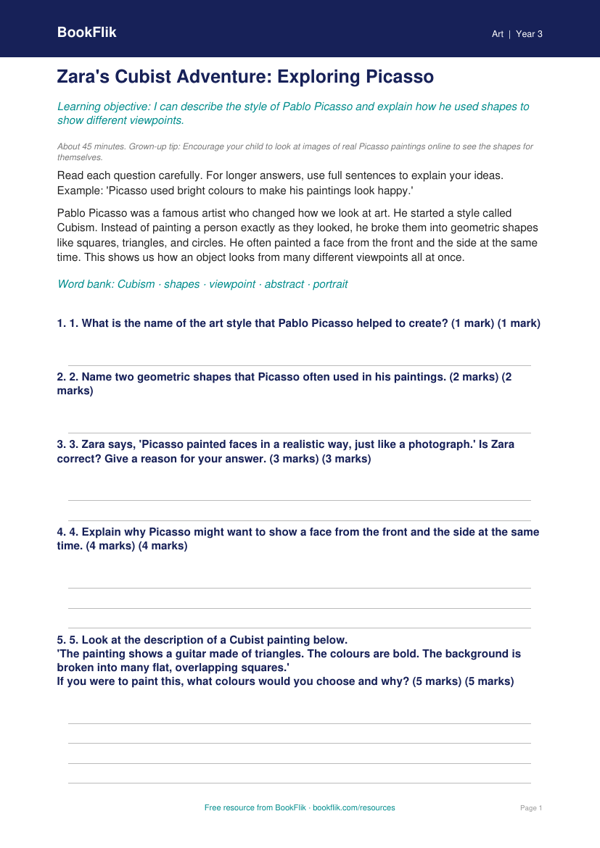
Boost your classroom creativity with our free Art picasso assessment year 3 core resource. This downloadable pack is designed to help teachers and parents evaluate how well pupils understand the life and unique style of Pablo Picasso. By exploring his famous cubism period, children will learn how to break down images into shapes and patterns, much like our friend Zara the zebra does when she looks at the world.
This Art picasso assessment year 3 core is fully aligned with the UK National Curriculum for Key Stage 2. It encourages children to develop their artistic skills by experimenting with colour and form. The resource includes a brief biography of Picasso written in simple, engaging language, followed by a series of creative tasks. Pupils will practice analysing famous artworks, identifying geometric shapes, and creating their own portraits in the cubist style.
Teachers and parents can use this Art picasso assessment year 3 core to track progress throughout the spring or summer term. It provides a clear way to see if children can compare different artistic styles and express their own opinions using subject-specific vocabulary. Whether you are in a busy London classroom or a quiet village school, these materials are ready to print and use immediately.
We have ensured the content is accessible for all learners working at the expected standard for Year 3. The assessment includes five to seven questions that range from simple recall to creative application, ensuring every child feels confident and encouraged. For fast finishers, we have included a fun extension task that challenges them to use their own sketching skills to reimagine a local scene, such as a garden robin or an oak tree, using Picasso’s bold, angular techniques. Download this resource today to bring the colourful world of art history to life for your Year 3 pupils.
How to use this assessment
- Time: about 45 minutes
- At home: Encourage your child to look at images of real Picasso paintings online to see the shapes for themselves.
- In the classroom: Use this after a practical art lesson where students have experimented with drawing faces using geometric shapes.
Preview the worksheet
If the preview does not load, open the PDF in a new tab.