
Free Algorithms Assessment | Year 6 Core | BookFlik
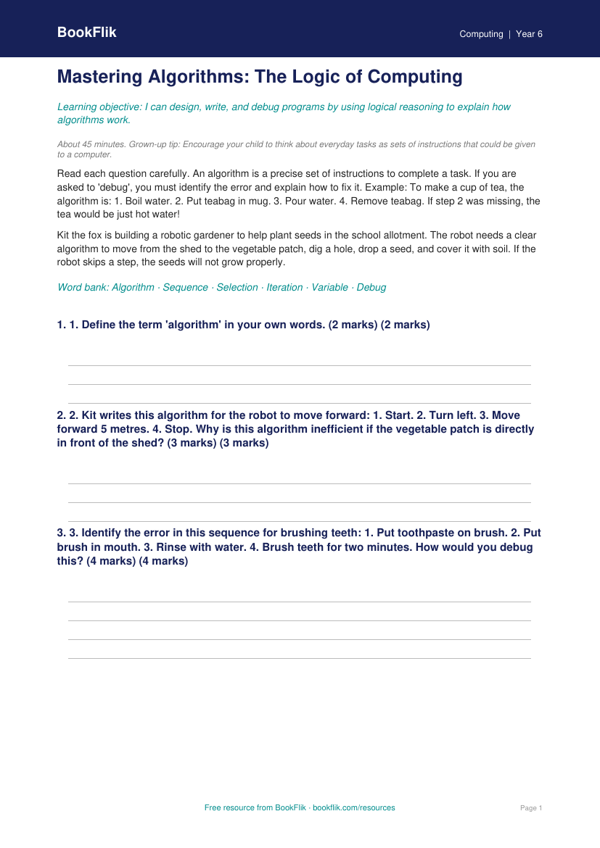
Boost your classroom or home learning with our high-quality Computing algorithms assessment year 6 core resource. Designed specifically for the UK National Curriculum, this assessment helps children master the logical steps required to design, write, and debug programmes. Whether you are a teacher planning a sequence of lessons or a parent supporting home education, this resource provides a clear way to track progress in computational thinking.
Our Computing algorithms assessment year 6 core covers essential skills including sequence, selection, and iteration. Pupils will be challenged to identify errors in code, predict the output of specific instructions, and construct their own efficient algorithms to solve real-world problems. By using the familiar characters of Kit the fox and Max the monkey, children engage with complex concepts through relatable, logic-based puzzles that mirror the standard expected at the end of Key Stage 2.
This resource is perfectly aligned with the UK National Curriculum requirements for upper Key Stage 2. It ensures that pupils can decompose complex problems and evaluate the effectiveness of their solutions. Because this is a Computing algorithms assessment year 6 core, it is pitched at the expected standard for Year 6 learners. The content is carefully scaffolded to support pupils in developing their confidence while providing extension tasks for those who are ready to explore more abstract reasoning.
Teachers can use this assessment as a formative tool to identify gaps in knowledge after completing a unit on programming. Parents will find it an excellent way to see how their children apply their maths and logic skills to computer science. With clear instructions and a focus on British English terminology, this assessment is ready to print and use immediately. Help your pupils build a strong foundation in programming and logical thinking today with our teacher-approved, curriculum-aligned materials.
How to use this assessment
- Time: about 45 minutes
- At home: Encourage your child to think about everyday tasks as sets of instructions that could be given to a computer.
- In the classroom: Focus on the precision of the language used; encourage students to use the key vocabulary in their explanations.
Preview the worksheet
If the preview does not load, open the PDF in a new tab.