
Free Debugging Activity Sheet | Year 3 Core | BookFlik
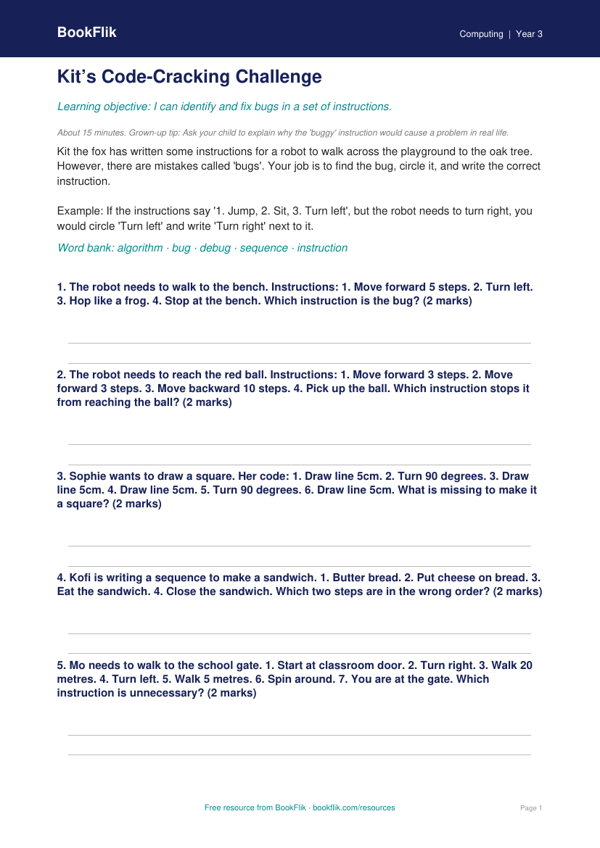
Boost your pupils’ logical thinking with our new Computing debugging activity sheet year 3 core. This resource is designed for teachers and parents who want to help children master the fundamentals of programming. In the Year 3 curriculum, pupils are expected to understand that programs execute precise instructions and that errors can occur. Our Computing debugging activity sheet year 3 core introduces these concepts through fun, relatable scenarios featuring Kit the fox.
In this lesson, Kit the fox has written a set of instructions for his friends to follow, but he has made a few silly mistakes. Children must act as digital detectives to identify the errors in his code. By spotting the bugs and correcting the sequences, learners will develop essential problem-solving skills. This Computing debugging activity sheet year 3 core encourages children to think like computer scientists by breaking down complex tasks into smaller, manageable steps.
This pack is perfectly aligned with the UK National Curriculum for Key Stage 2. It helps pupils understand how to detect and correct errors in algorithms. The resource is set at the core level, which is the expected standard for seven and eight-year-olds. It uses clear, British English throughout, ensuring the language is accessible for all learners in the classroom or at home.
Teachers can use this sheet as an independent task during an ICT lesson or as a quick morning starter. Parents can also use it to support learning at home, turning a simple logic puzzle into an engaging educational game. We have included an extension task for fast finishers, challenging them to write their own set of instructions for a partner to debug. Download this free resource today to help your students become confident, creative, and precise programmers while they develop the resilience needed to solve any digital puzzle they encounter.
How to use this activity sheet
- Time: about 15 minutes
- At home: Ask your child to explain why the ‘buggy’ instruction would cause a problem in real life.
- In the classroom: Encourage pupils to act out the instructions physically to see where the ‘bug’ happens.
Preview the worksheet
If the preview does not load, open the PDF in a new tab.