
Free Programming Activity Sheet | Year 3 Core | BookFlik
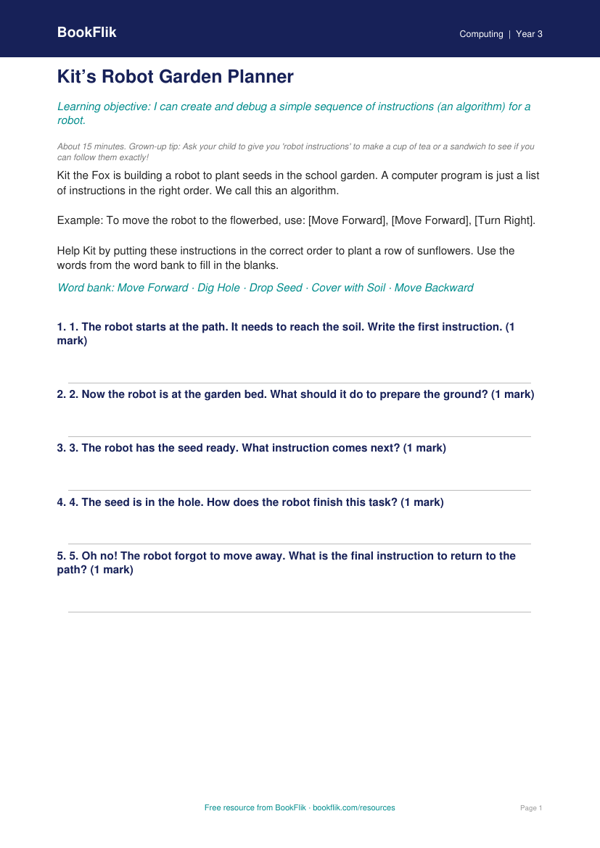
Boost your pupils’ logical thinking with our new Computing programming activity sheet year 3 core resource. Designed specifically for the UK National Curriculum, this engaging worksheet helps children aged 7-8 understand the fundamentals of algorithms and sequence.
In this lesson, our friendly character Kit the fox leads children through a series of fun coding challenges. Learners will discover how to give clear, step-by-step instructions to navigate a robot across a map of a bustling London park. By breaking down complex tasks into smaller, manageable steps, students gain confidence in their ability to debug simple programmes. This Computing programming activity sheet year 3 core focuses on the core requirements of Key Stage 2, ensuring that children can design, write, and debug programmes that accomplish specific goals.
Teachers and parents can use this resource to support classroom learning or as a home-based enrichment task. The sheet uses familiar scenarios, such as helping a hedgehog find its way home through a garden, to make abstract concepts feel concrete and exciting. The activities are perfectly aligned with the Year 3 Computing curriculum, focusing on the use of logical reasoning to predict the behaviour of simple programmes.
This Computing programming activity sheet year 3 core is set at the expected standard for Year 3 pupils. It includes five recall and application questions that encourage students to think like computer scientists. We have also included a brief extension challenge at the bottom of the page for fast finishers who want to test their skills with more complex sequences.
Download this free, high-quality resource today to bring digital literacy to life in your classroom. With clear instructions and a supportive tone, it is the perfect tool to help your learners master the basics of sequencing and logic while having fun with Kit the fox.
How to use this activity sheet
- Time: about 15 minutes
- At home: Ask your child to give you ‘robot instructions’ to make a cup of tea or a sandwich to see if you can follow them exactly!
- In the classroom: Encourage pupils to act out their sequence physically to see if their algorithm successfully completes the task.
Preview the worksheet
If the preview does not load, open the PDF in a new tab.