
Free Scratch Word Mat | Year 5 Greater Depth | BookFlik
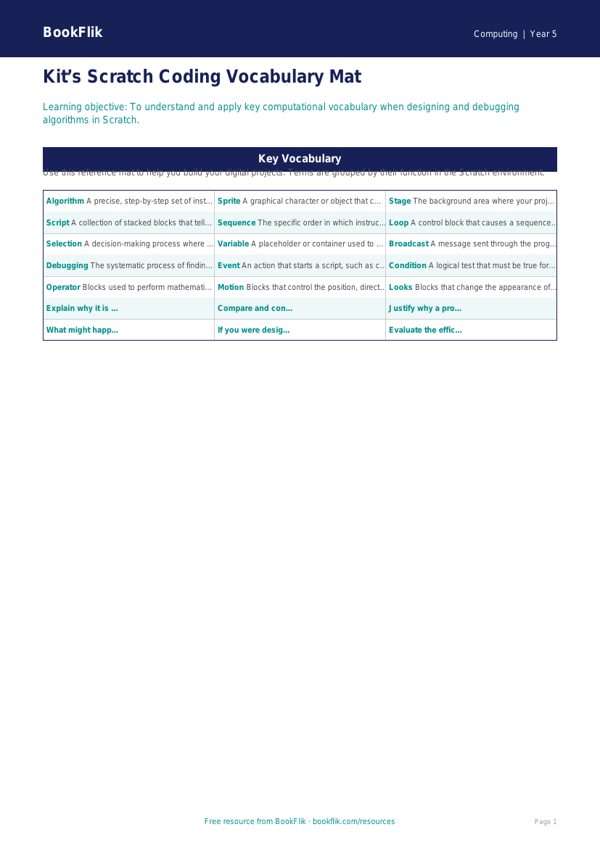
Elevate your classroom coding sessions with our premium Computing scratch word mat year 5 greater depth resource. Designed specifically to challenge high-attaining pupils, this comprehensive mat transcends basic block identification, moving into the realms of computational thinking and algorithmic refinement.
As Kit the fox often says, a clever solution starts with a logical plan. This resource aligns perfectly with the UK National Curriculum for Computing, focusing on key stage 2 requirements such as designing, writing, and debugging programs that accomplish specific goals. While many learners focus on simple loops, this Computing scratch word mat year 5 greater depth encourages students to master complex concepts including nested loops, conditional statements, and the use of broadcast blocks to manage multi-sprite interactions.
Teachers can use this mat as a desk-side reference to support independent learning or as a prompt for peer-led debugging sessions. By providing precise terminology—such as variables, Boolean logic, and broadcast events—the mat empowers children to articulate their programming logic with confidence and professional clarity.
This resource is crafted for the greater depth learner who is ready to move beyond basic movement scripts. It introduces the vocabulary required to create sophisticated games and simulations, ensuring pupils understand the ‘why’ behind the code. The mat is ideal for differentiation, allowing gifted learners to explore the nuances of event-driven programming while the rest of the class builds their foundations.
Our Computing scratch word mat year 5 greater depth includes eight challenging tasks designed to stretch inquisitive minds:
1. Explain why a variable is essential for creating a high-score system in a game.
2. Compare and contrast the use of repeat loops versus forever loops.
3. Justify your decision to use a broadcast block instead of a standard wait command.
4. What might happen if your conditional statement is placed outside of a loop?
5. Design an algorithm for a sprite to navigate a maze using nested logic.
6. Analyse a piece of buggy code and describe your step-by-step debugging process.
7. Create a sequence using a variable to track the number of lives a player has.
8. Propose a way to modify a project to make it more efficient for the computer to process.
Preview the worksheet
If the preview does not load, open the PDF in a new tab.