
Free Mechanisms Writing Frame | Year 4 Greater Depth | BookFlik
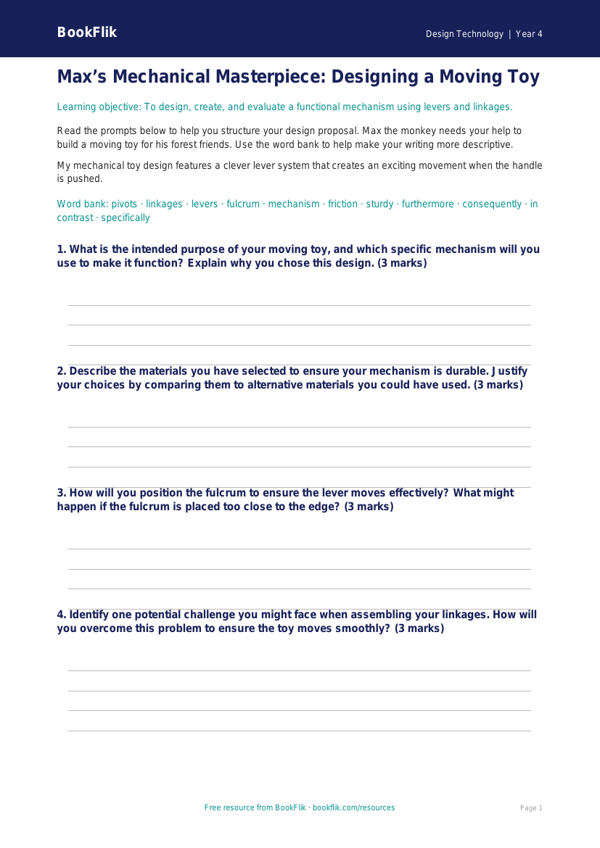
Unlock your pupils’ potential with our premium Design Technology mechanisms writing frame year 4 greater depth resource. Specifically crafted for Year 4 students, this comprehensive tool supports learners in articulating the complex mechanical principles behind their inventions. By using this Design Technology mechanisms writing frame year 4 greater depth, children will move beyond simple descriptions, learning to evaluate how levers, linkages, and cams function within their own original models.
Our resource is perfectly aligned with the UK National Curriculum, which requires pupils to understand how mechanical systems can create movement. Max the monkey, our resident maths and logic expert, guides students through the structural analysis of their designs. The writing frame encourages pupils to use technical vocabulary, such as pivot, fulcrum, and rotary motion, ensuring their explanations are both precise and sophisticated.
Teachers can use this resource to scaffold the planning phase of a design project or as a reflective summary after the construction phase. Because this Design Technology mechanisms writing frame year 4 greater depth is designed for learners exceeding age-related expectations, it includes higher-order thinking prompts that demand justification and analytical reasoning.
The resource features eight challenging tasks, including:
1. Explain why a specific pivot point was chosen to increase the mechanical advantage of your lever.
2. Compare and contrast the motion of a slider mechanism with a rotary cam.
3. Justify your material choices based on the forces acting upon your mechanism.
4. What might happen if the fulcrum was moved closer to the load?
5. Analyse the stability of your frame when the mechanism is in operation.
6. Propose a modification to make your design more efficient.
7. Sketch a diagram and label the input and output forces.
8. Creative extension: Design a new mechanism to solve a real-world problem for someone in your local community.
Download this free resource today to inspire your young engineers to think critically and write with technical flair.
Preview the worksheet
If the preview does not load, open the PDF in a new tab.