
Free Prototyping Word Mat | Year 5 Greater Depth | BookFlik
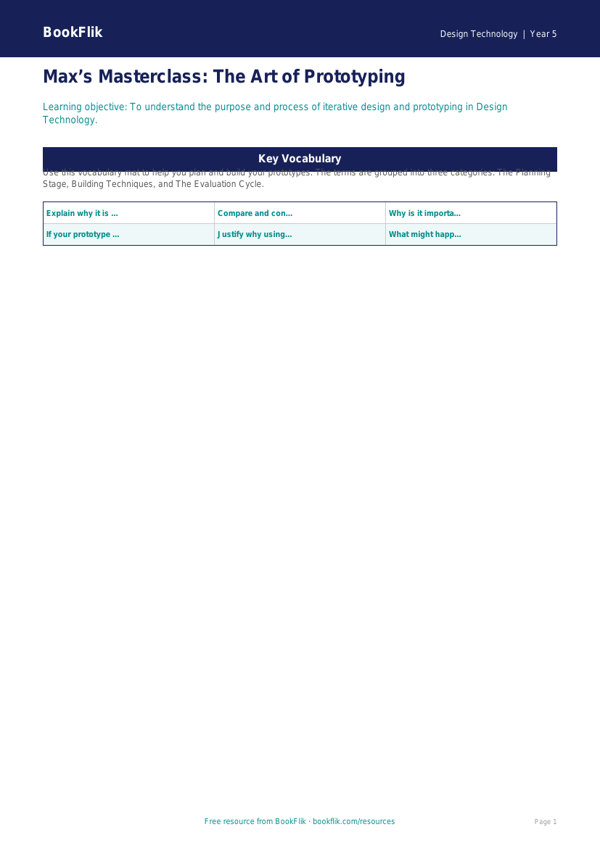
Elevate your classroom resources with our comprehensive Design Technology prototyping word mat year 5 greater depth. Specifically curated for Year 5 pupils, this professional-grade resource is designed to bridge the gap between initial concepts and functional final products. As students transition from simple construction to more complex iterative design, this word mat provides the sophisticated vocabulary necessary to document their creative journeys effectively.
By using this Design Technology prototyping word mat year 5 greater depth, learners will explore essential technical terminology such as iteration, aesthetic appeal, structural integrity, ergonomics, and functional testing. The mat encourages children to articulate why they have chosen specific materials or joints, pushing them to evaluate their prototypes with a critical, engineering-focused eye. Teachers can use this as a scaffold during the planning phase or as a prompt for reflective journals, ensuring that pupils move beyond basic descriptions towards analytical evaluations of their work.
Aligned with the UK National Curriculum, this resource supports the requirement for pupils to generate, develop, model, and communicate their ideas through annotated sketches, cross-sectional diagrams, and computer-aided design. The content is tailored to meet the needs of pupils exceeding age-related expectations, offering a challenge that demands higher-order thinking.
Within this Design Technology prototyping word mat year 5 greater depth, you will find six to eight rigorous questions designed to stretch the most capable learners. These include prompts such as: Justify why your chosen material is suitable for the prototype’s intended purpose; Compare and contrast the benefits of a cardboard model versus a 3D-printed component; and What might happen to your final product if the structural integrity of your prototype is compromised?
Download this free, high-quality educational tool today to inspire the next generation of inventors, engineers, and designers in your classroom. It is the perfect resource for fostering a deeper, more resilient approach to the iterative design process.
Preview the worksheet
If the preview does not load, open the PDF in a new tab.