
Free Diary Writing Drawing Sheet | Year 4 Greater Depth | BookFlik
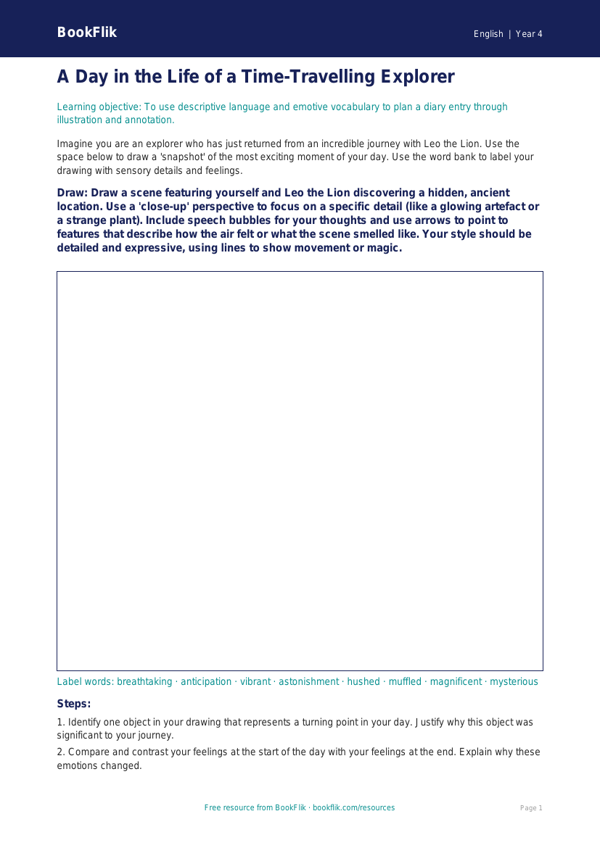
Unlock your pupils’ creative potential with our bespoke English diary writing drawing sheet year 4 greater depth resource. Designed specifically for Key Stage 2 learners who are ready to push the boundaries of their creative expression, this printable activity helps children bridge the gap between visual storytelling and sophisticated narrative structure.
Our English diary writing drawing sheet year 4 greater depth encourages students to map out the emotional landscape of their characters before they put pen to paper. By using visual prompts and structured planning boxes, children learn to identify key plot points, sensory details, and internal monologues. This aligns perfectly with the UK National Curriculum requirement for Year 4 pupils to draft and write by composing and rehearsing sentences orally and in writing, as well as considering how authors develop characters and settings.
Teachers can use this resource as a bridge to complex creative writing tasks. It is ideal for independent work or as a guided classroom activity where children can annotate their sketches with advanced vocabulary and emotive adjectives. Because this English diary writing drawing sheet year 4 greater depth is differentiated, it moves beyond simple chronological recount. It challenges gifted learners to consider perspective, tone, and the ‘show, don’t tell’ technique.
To challenge your high-achieving writers, we have included the following deeper thinking questions:
1. Explain why the character’s feelings change between the beginning and the end of the diary entry.
2. Compare and contrast how a character describes a setting versus how a reader might perceive it.
3. Justify your choice of vocabulary to describe a specific emotional state.
4. What might happen if the character’s internal perspective shifted suddenly?
5. How does the layout of your drawing influence the pace of your written story?
6. Create an extension: Write a paragraph from the perspective of an antagonist observing the main character’s actions.
Preview the worksheet
If the preview does not load, open the PDF in a new tab.