
Free Musical Elements Word Mat | Year 5 Greater Depth | BookFlik
Enhance your classroom music provision with our comprehensive Music musical elements word mat year 5 greater depth resource. Designed specifically for Year 5 pupils, this high-quality, printable tool is essential for students moving beyond basic definitions to explore the sophisticated building blocks of composition and performance.
This resource supports the UK National Curriculum objective of understanding and using musical notation and terminology. Instead of simple descriptors, our word mat introduces advanced vocabulary such as polyphony, syncopation, timbre, and crescendo, encouraging children to articulate their critical listening skills with precision. By using this Music musical elements word mat year 5 greater depth, teachers can foster an environment where children confidently evaluate their own compositions and the works of others using accurate, technical language.
The mat is perfect for independent work, small group discussions, or as a scaffold during whole-class composition tasks. Because it is designed for greater depth, the resource includes complex terminology that challenges gifted and talented learners to analyse the texture, structure, and dynamics of a piece of music rather than just identifying a beat. Whether pupils are composing original melodies or appraising orchestral performances, this Music musical elements word mat year 5 greater depth provides the perfect linguistic foundation.
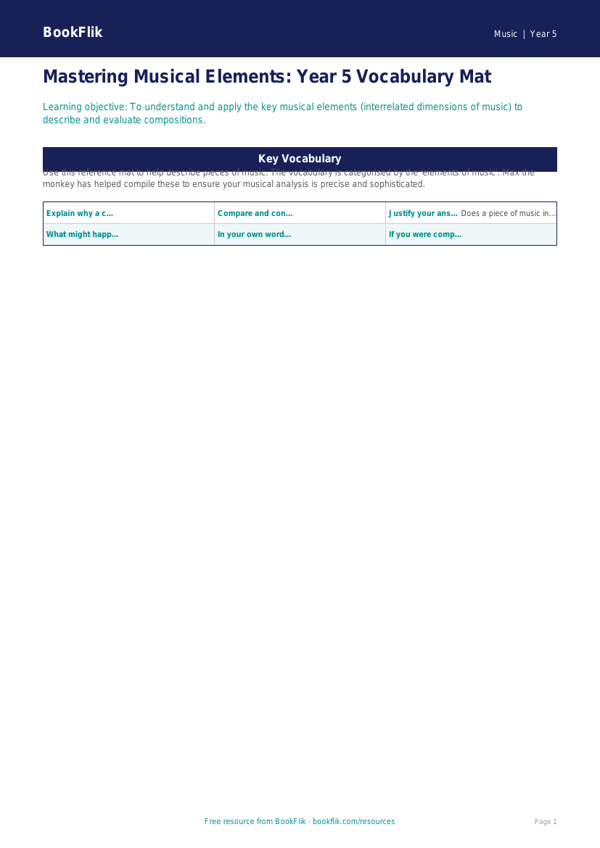
Included in the download are six higher-order thinking questions designed to stretch the most able learners. These include:
1. Explain why a composer might choose a staccato articulation to convey a specific mood.
2. Compare and contrast the effect of a homophonic texture versus a polyphonic texture in a choral arrangement.
3. Justify your choice of tempo and dynamics when composing a piece intended to represent a storm.
4. What might happen if a composer ignored the importance of timbre in an orchestral score?
5. How does the use of syncopation alter the listener’s perception of a piece’s pulse?
6. Create a short composition plan using at least four of the advanced terms provided on the mat.
Preview the worksheet
If the preview does not load, open the PDF in a new tab.