
Free Yoga Word Mat | Year 5 Greater Depth | BookFlik
Enhance your physical education lessons with our comprehensive Pe yoga word mat year 5 greater depth resource. Designed specifically for UK National Curriculum Key Stage 2 pupils, this printable aid moves beyond basic terminology to challenge students with sophisticated anatomical and physiological vocabulary.
In Year 5, children are expected to refine their control, balance, and flexibility. This Pe yoga word mat year 5 greater depth resource supports these physical goals by introducing precise terminology such as proprioception, core stabilisation, respiratory rhythm, and musculoskeletal alignment. By incorporating these terms into their practice, pupils develop a deeper understanding of how their bodies function during complex movement sequences.
Teachers can use this resource to facilitate peer-led warm-ups or as a reference during creative choreography tasks. For gifted and talented learners, this mat acts as a springboard for scientific inquiry. Instead of simply performing a pose, students are encouraged to articulate the mechanical advantage of a stretch or the physiological benefits of controlled breathing. The resource aligns with the statutory requirement for pupils to compare their performances with previous ones and demonstrate improvement to achieve their personal best.
This Pe yoga word mat year 5 greater depth material is perfect for differentiation. While some students focus on mastering foundational postures, those seeking greater depth can explore the nuances of kinetic energy, the importance of muscle groups, and the meditative aspects of mindfulness in sport.
Use the following questions to challenge your learners:
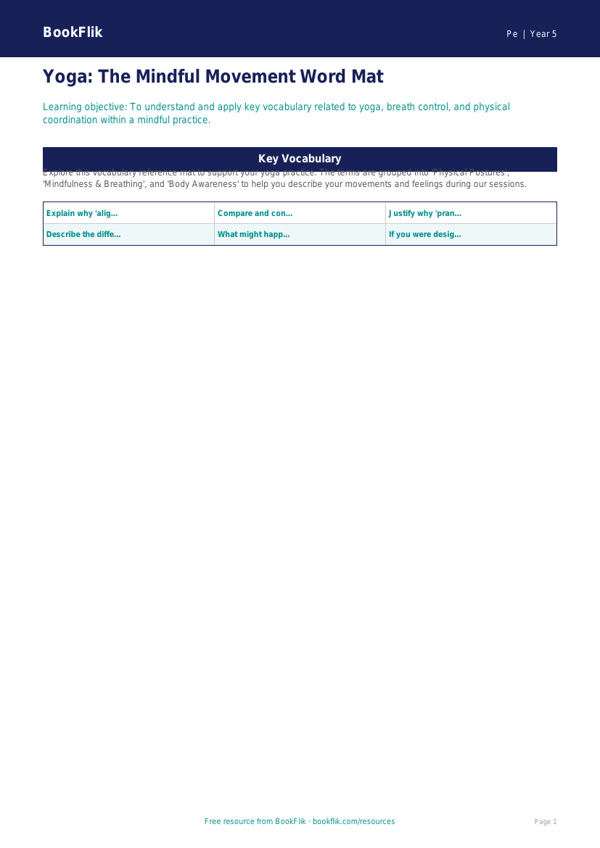
1. Explain why maintaining a neutral spine is essential for safety during forward folds.
2. Compare and contrast static and dynamic stretching techniques.
3. Justify your answer: How does rhythmic breathing influence your heart rate during a sequence?
4. What might happen if your core muscles were not engaged during a balancing pose?
5. Analyse the pattern of your movement; how can you improve the fluidity of your transition?
6. Create an original sequence of four poses and document the specific muscles engaged in each.
Preview the worksheet
If the preview does not load, open the PDF in a new tab.