
Free Life After Death Drawing Sheet | Year 5 Greater Depth | BookFlik
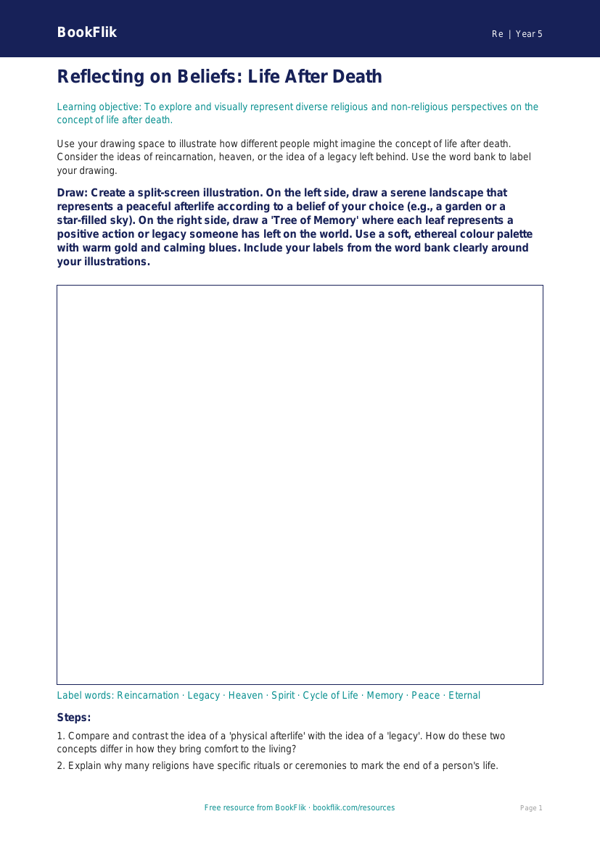
Explore profound philosophical and theological concepts with our exclusive Re life after death drawing sheet year 5 greater depth resource. Designed specifically for Year 5 pupils, this creative tool encourages students to move beyond surface-level understanding, inviting them to express complex abstract ideas through visual storytelling and symbolic representation.
This Re life after death drawing sheet year 5 greater depth is meticulously crafted to align with the UK National Curriculum, focusing on the exploration of diverse religious and non-religious perspectives regarding the afterlife. While younger learners might focus on simple narratives, this resource challenges gifted and talented students to synthesise information from various worldviews, including Christianity, Islam, Hinduism, and Humanism. By sketching metaphors, pupils can articulate nuanced thoughts on legacy, reincarnation, heaven, or the cycle of nature.
Teachers can use this resource as a bridge between classroom discussions and independent reflection. It provides a structured yet open-ended space for students to synthesise their knowledge of eschatological beliefs. Our Re life after death drawing sheet year 5 greater depth serves as an excellent prompt for philosophical debate, encouraging children to justify their artistic choices using enriched vocabulary such as ‘transcendence’, ‘legacy’, ‘metaphor’, and ‘perspective’.
Beyond the drawing task, the resource includes six high-level questions designed for greater depth learners. These include:
1. Explain why different religions might hold contrasting views on what happens after death.
2. Compare and contrast the concept of a soul with the idea of a physical legacy.
3. Justify your answer: Does a person continue to exist through the impact they have on others?
4. What might happen to our understanding of morality if humans did not believe in an afterlife?
5. Create a symbolic representation of ‘eternity’ without using religious imagery.
6. How can art help us process difficult questions that have no definitive factual answer?
Download this resource today to inspire thoughtful, respectful, and sophisticated theological enquiry in your classroom.
Preview the worksheet
If the preview does not load, open the PDF in a new tab.