
Free Skeleton And Muscles Flashcards | Year 5 Greater Depth | BookFlik
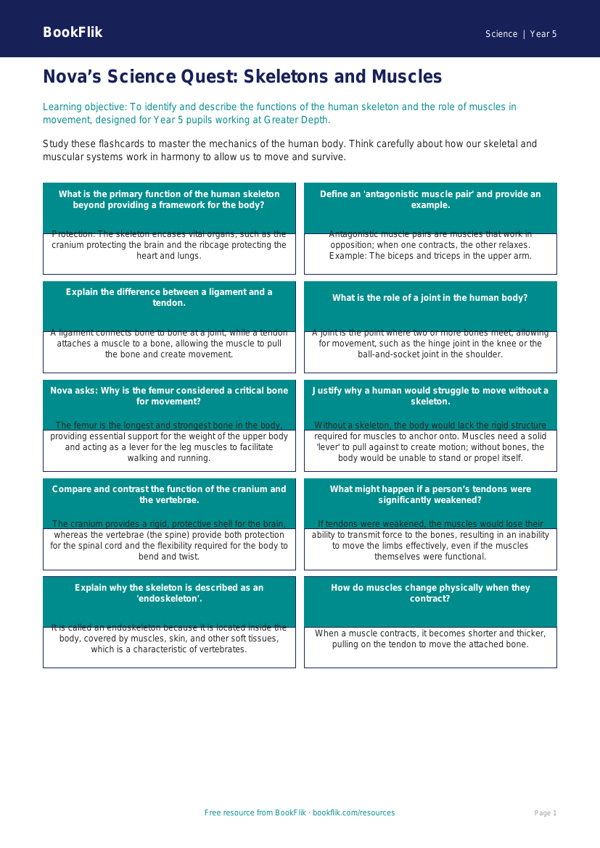
Enhance your classroom resources with our comprehensive Science skeleton and muscles flashcards year 5 greater depth set. Designed specifically for pupils working at a higher level, these materials move beyond basic anatomical identification to explore the complex mechanics of the human musculoskeletal system.
In line with the UK National Curriculum, these resources support the study of how humans develop and the function of the skeleton and muscles. Pupils will investigate the antagonistic muscle pairs responsible for movement, the biomechanics of joints, and the structural differences between endoskeletons and exoskeletons. By using these Science skeleton and muscles flashcards year 5 greater depth, learners will deepen their understanding of how the body maintains posture, protects vital organs, and facilitates locomotion through intricate biological processes.
Teachers can utilise these flashcards for targeted small-group intervention, independent research stations, or as a catalyst for high-level classroom debate. Because these Science skeleton and muscles flashcards year 5 greater depth are designed for gifted and talented learners, each card features advanced terminology and thought-provoking prompts that require synthesis and evaluation rather than simple recall.
The pack includes six rigorous challenge questions designed to stretch cognitive abilities:
1. Explain why the triceps and biceps must act as an antagonistic pair to move the forearm.
2. Compare and contrast the protective functions of the cranium and the rib cage.
3. Justify the importance of synovial fluid in a hinge joint.
4. What might happen if a human’s tendons were replaced by rigid bone?
5. Evaluate the impact of a sedentary lifestyle on the long-term density and health of the skeletal system.
6. Create an original scientific diagram demonstrating how a specific muscle group attaches to bone via a tendon.
Download these teacher-created resources today to provide your Year 5 cohort with the sophisticated scientific vocabulary and conceptual challenge required for academic excellence.
Preview the worksheet
If the preview does not load, open the PDF in a new tab.