
Free Skeleton And Muscles Poster | Year 5 Greater Depth | BookFlik
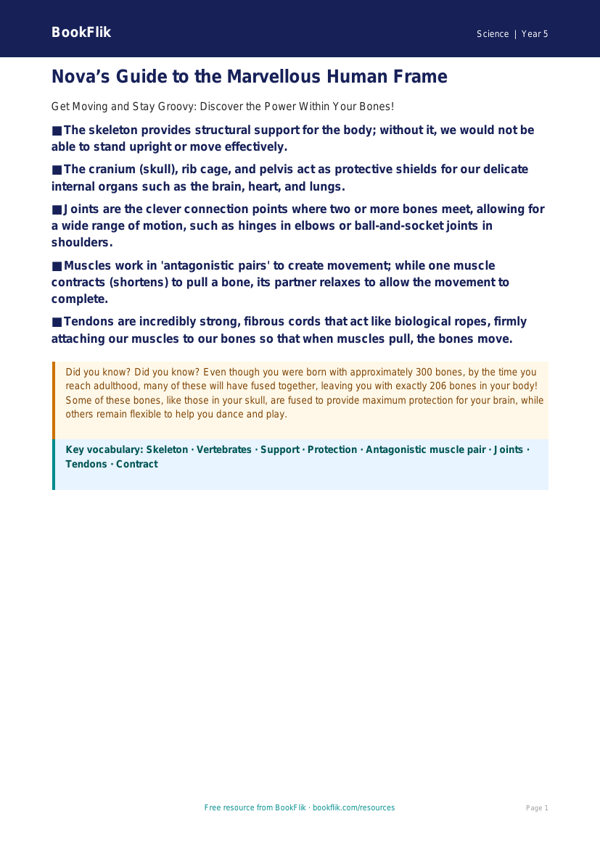
Enhance your classroom walls with our comprehensive Science skeleton and muscles poster year 5 greater depth resource. Designed specifically for ambitious learners, this educational display goes beyond basic labelling to explore the intricate biomechanics of the human body. As pupils engage with this Science skeleton and muscles poster year 5 greater depth, they will investigate the relationship between the axial and appendicular skeleton, the physiological function of joints, and the mechanics of antagonistic muscle pairs.
Aligned with the UK National Curriculum for Year 5, this resource supports the requirement for children to identify that humans have skeletons and muscles for support, protection, and movement. While standard resources focus on naming bones, this advanced material encourages critical thinking by examining how structural adaptations facilitate locomotion and stability.
Teachers can utilise this Science skeleton and muscles poster year 5 greater depth as a springboard for inquiry-based learning. It is perfect for small-group rotations or as a focal point for a Socratic seminar on human biology. The accompanying challenge sheet is meticulously differentiated to stretch gifted and talented students, moving them from simple identification to complex synthesis.
The resource includes six high-level questions designed to foster deeper understanding:
1. Explain why the human skeleton is described as an endoskeleton rather than an exoskeleton.
2. Compare and contrast the ball-and-socket joint in the shoulder with the hinge joint in the elbow. What are the biomechanical advantages of each?
3. Justify your answer: Why is it essential for muscles to work in antagonistic pairs rather than acting alone?
4. What might happen to a person’s movement if their tendons were replaced with inelastic material?
5. How does the structure of the cranium protect the brain compared to the structure of the ribcage protecting the heart and lungs?
6. Extension Task: Design an experiment to measure the rate of muscle fatigue in the bicep during repetitive flexion.
Preview the worksheet
If the preview does not load, open the PDF in a new tab.